Get Full Government Meeting Transcripts, Videos, & Alerts Forever!
Get email alerts on the Public Works Bonds topic
No spam. Unsubscribe anytime.
Public Works updates bond oversight committee: SFGH closeout near completion, subcontractor claim and 2016 bond program risks outlined
Summary
Public Works told the bond oversight committee the 2008 San Francisco General Hospital rebuild is near administrative closeout but faces a subcontractor cost claim; staff also summarized the 2016 Public Health and Safety bond program, seismic retrofit needs at several health centers, and schedule changes for the 440 Turk homeless resource project.
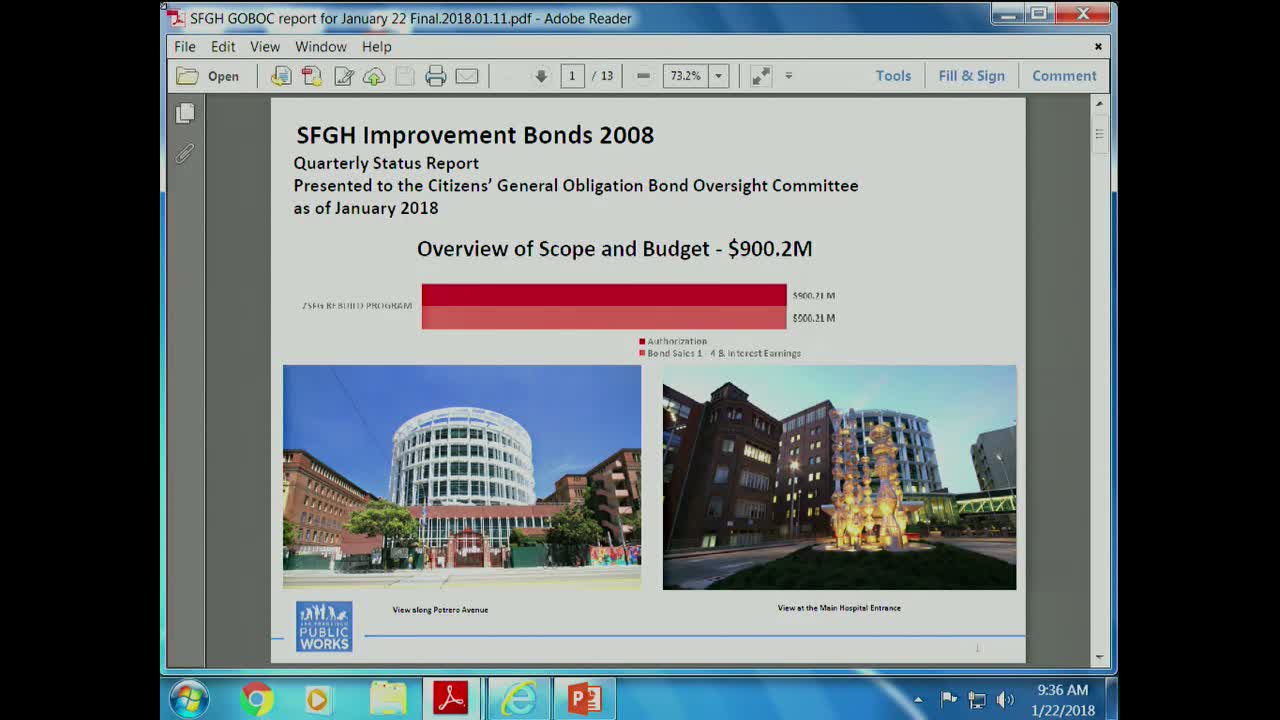
Joe Chin of Public Works told the bond oversight committee that the 2008 San Francisco General Hospital (SFGH) rebuild is largely complete but still requires a final reconciliation of OSHPD permit fees before formal closeout. "For all intended purposes, the rebuild bond program has been completed," Chin said, adding that patient occupancy at the new Zuckerberg General Hospital occurred in May 2016 and final project closeout work finished that July.
Chin and committee members discussed a pending subcontractor claim that Webcor (the general contractor) has isolated with a cross-complaint. Chin said he has forwarded the matter to the city attorney for review. Committee members asked about potential exposure; one member asked, "what's the total financial risk of this claim?" Staff estimated the subcontractor’s claim could be as high as $18–20 million. Chin said about $12.2 million remained in the project account, with roughly $5 million set aside for soft costs, $3–4 million anticipated OSHPD fees, approximately $3–3.6 million for construction contracts, and other small contingencies.
On the 2016 Public Health and Safety bond program, Chin provided an executive summary of six component areas spanning three client departments: Department of Public Health, Fire Department, and the Department of Homelessness and Supportive Housing. He described program milestones and risks, including an adverse bidding environment and a shortage of qualified subcontractors. Regarding community health centers, Chin said seismic assessments found ratings in the 3+ to 4 range for several facilities and that the Chinatown Public Health Center "will most likely be deferred to a future bond" because of the additional retrofit scope.
Chin also described budget reallocation inside the fire component: $5.1 million was shifted from neighborhood fire stations to the Ambulance Deployment Facility (ADF) so the ADF could be delivered as a complete project while the fire department’s total allocation remained $58 million. For the homeless services component, Chin said a previously proposed emergency procurement for 440 Turk Street was withdrawn and the team will now pursue a traditional RFQ and design-build procurement, pushing the RFQ advertisement into spring 2018.
Committee members pressed staff on oversight, voter expectations and the degree to which bond ordinances constrain reallocation. Controller’s office staff and committee members discussed whether programmatic allocations are embedded in bond ordinances and affirmed that while programmatic allocations exist, the bond indentures and ordinance language determine allowable reallocations. Several members asked staff to relay these concerns to the Capital Planning Committee during upcoming ordinance drafting and to consider stronger pre-bond planning, including seismic and soils assessments, before future measures go to voters.
The committee did not take a formal board action on the items presented; staff committed to follow up with the city attorney on the subcontractor claim, to provide additional closeout and audit materials when available, and to include Department of Public Health representation at a future meeting to address programmatic service questions.