Get Full Government Meeting Transcripts, Videos, & Alerts Forever!
Get email alerts on the Building Codes Highrise Roofs topic
No spam. Unsubscribe anytime.
City officials to press State Fire Marshal over new interpretation that treats occupied roofs as floors
Summary
DBI staff, the fire department and housing officials agreed to convene the State Fire Marshal and local stakeholders after a written interpretation said occupied roofs count as 'occupied floors' for the 75-foot high‑rise threshold — a change that could add sprinkler, alarm and construction requirements and squeeze affordable housing projects.
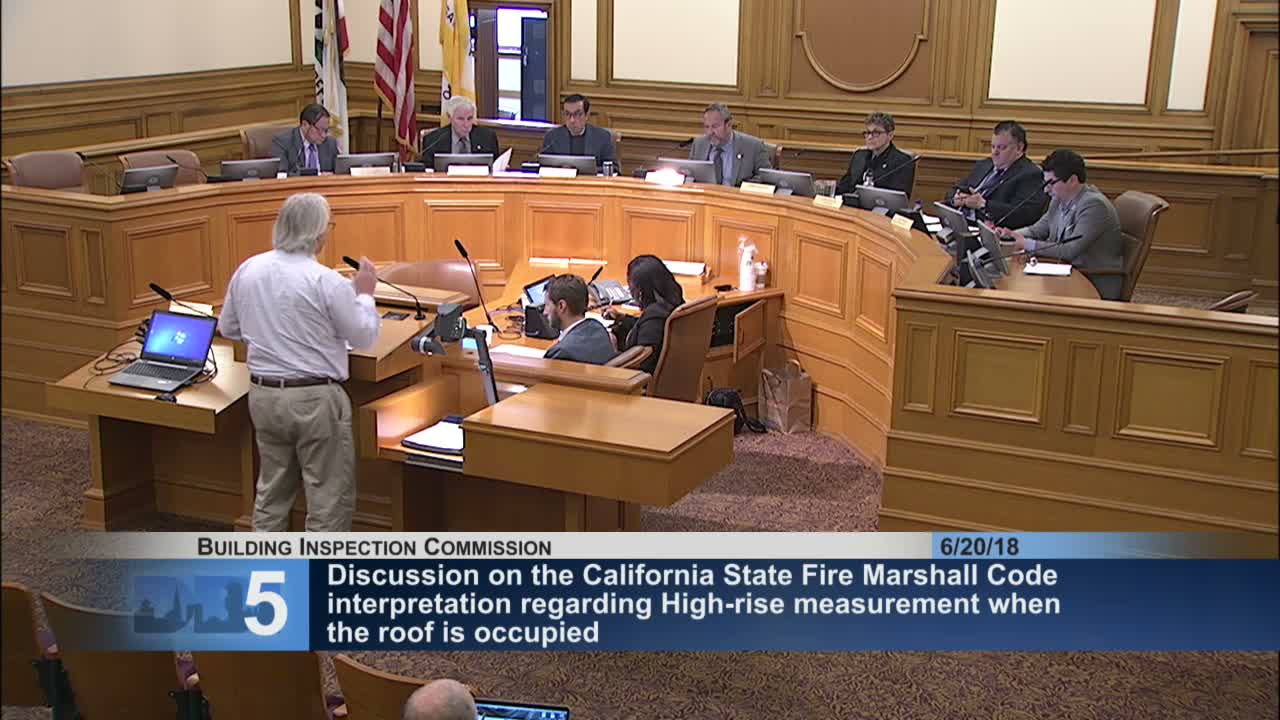
Kirk Means, DBI technical services chief, told the Building Inspection Commission on June 20 that a recent written interpretation from the State Fire Marshal answers "yes" to whether an occupied roof is considered an "occupied floor" for measuring the high‑rise threshold under the California Building Code.
"The answer from the State Fire Marshal is yes an occupied roof is considered an occupied floor," Means said, noting the prior understanding under the Uniform Building Code (1997) and earlier commentary excluded open roofs and roof decks from that measurement. The change, Means said, would require additional systems — sprinklers, alarms and other high‑rise protections — on buildings that cross the 75‑foot threshold.
Olivia Scanlon, government relations for the San Francisco Fire Department, told commissioners that the department must follow State Fire Marshal interpretations but acknowledged communication gaps and offered to convene the State Fire Marshal with local fire and building officials, housing representatives, developers and elected officials to "start those discussions." She said she would reach out to the State Fire Marshal and hoped to pull a meeting together quickly.
Erin Carson of the Mayor's Office of Housing and Community Development cautioned that reclassifying many rooftop‑deck projects as high‑rises would sharply raise construction costs for the city’s typical affordable housing prototypes. "It never pencils out in the types of projects that we do," she said, urging the city to pursue life‑safety solutions that preserve housing capacity.
Commissioners pressed for clarity on which projects would be protected by earlier permit application dates; Means said permit application date governs grandfathering, so projects with earlier application dates would likely remain under the old interpretation. He also flagged state code‑cycle deadlines that could determine when any interpretive or code changes would be incorporated.
The commission and staff agreed to pursue an interagency sit‑down that would include the State Fire Marshal's office, the local fire marshal, DBI, housing staff, affordable‑housing developers and other stakeholders to assess whether a San Francisco‑specific accommodation is feasible or whether broader code changes are required. DBI and the fire department will coordinate next steps and aim to convene the first meeting promptly.