Get Full Government Meeting Transcripts, Videos, & Alerts Forever!
Get email alerts on the Housing Policy topic
No spam. Unsubscribe anytime.
OCII adopts city housing preferences for successor‑agency affordable units
Summary
The commission approved a resolution applying Chapter 47 city housing preferences (certificate of preference, displaced tenant housing preference, neighborhood resident housing preference and others) to OCII‑funded affordable housing where consistent with enforceable obligations, affecting roughly 4,600 pipeline units and specific upcoming projects.
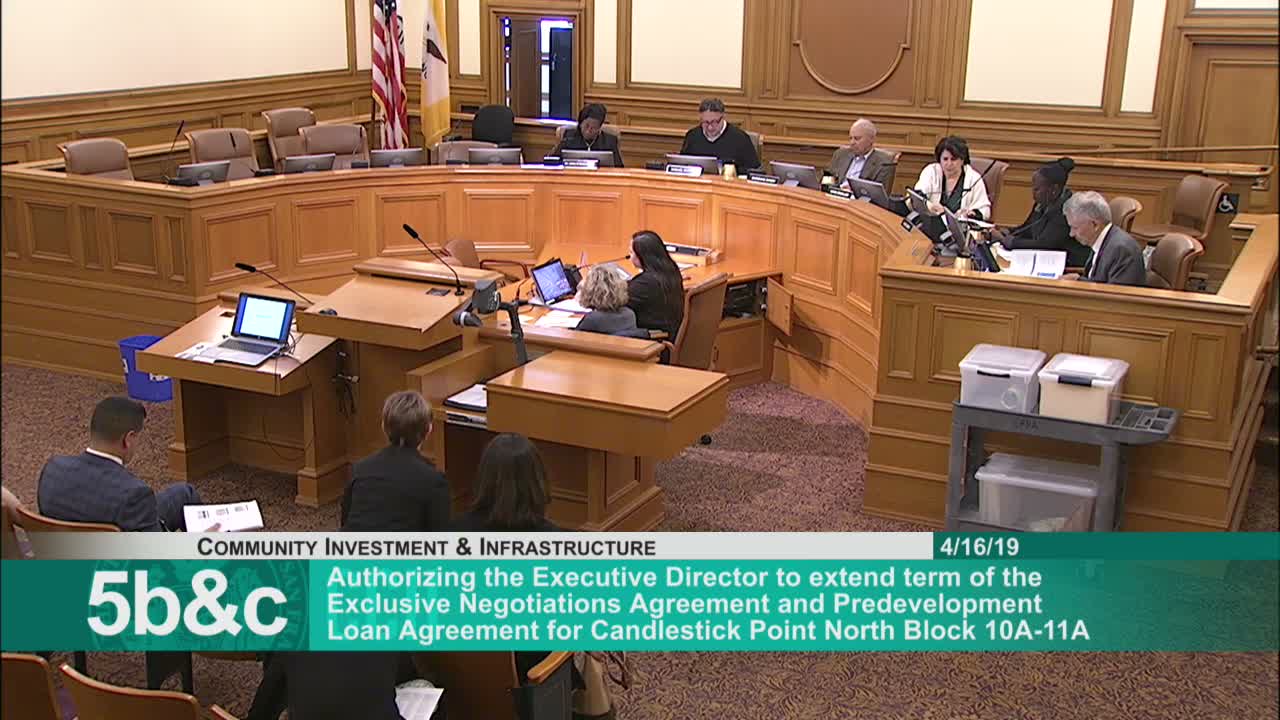
The Commission on Community Investment and Infrastructure voted April 16 to apply San Francisco’s city housing preferences (per Chapter 47 of the San Francisco Administrative Code) to OCII developments where consistent with redevelopment enforceable obligations and other applicable law. The item (5d, resolution 9‑2019) implements the city’s Certificate of Preference (COP) program, the Displaced Tenant Housing Preference (including Ellis Act, owner move‑ins and fire displacees), the Neighborhood Resident Housing Preference (NRHP) at 40% (or 25% where state funding requires), and the Live/Work in San Francisco preference.
Pam Sims of OCII’s Housing Division presented the policy package and explained how the preferences will be applied and ordered in lottery processes and lease‑ups. Sims and MOHCD representatives showed past implementation data: from July 1, 2016 through June 30, 2018 MOHCD reported 48 applicants successfully used COP, 69 used the displaced tenant preference and 188 used the neighborhood resident housing preference in MOHCD sales and lease ups. OCII staff said Transbay Block 1, Transbay Block 9, and Mission Bay South Block 3 East Marketplace units would be among the first to use the preferences under the OCII application.
Commissioners asked detailed questions about how preferences interact in the lottery system, what documentation is required, the half‑mile neighborhood radius, marketing and outreach responsibilities, and administrative lists of preference holders. Maria Benjamin from the Mayor’s Office of Housing and Community Development explained that the Dahlia application system flags neighborhood eligibility and that lots set aside for displaced tenants (20% for DTHP) are run separately and, if applicants are not housed under that preference, revert to the general lottery ranking. OCII staff said they maintain lists of COP and displaced tenant holders and that roughly 35 OCII projects are in the pipeline that could use NRHP preferences.
Public comment (Oscar James) supported expanded preferences and suggested adding COP holders’ descendants to eligibility; commissioners asked staff to consider that policy question for future review. The commission approved the resolution by roll call (4 ayes). Staff said they will produce annual reports on preference effectiveness and will update the commission when new projects implement the preferences.
The action does not itself change unit counts but modifies the applicant preference structure used in lotteries and lease‑ups for OCII projects where legally allowable.