Get Full Government Meeting Transcripts, Videos, & Alerts Forever!
Get email alerts on the Transbay Grocery Obligation topic
No spam. Unsubscribe anytime.
OCII votes to release Related from Transbay Block 8 grocery obligation after staff finds good‑faith efforts
Summary
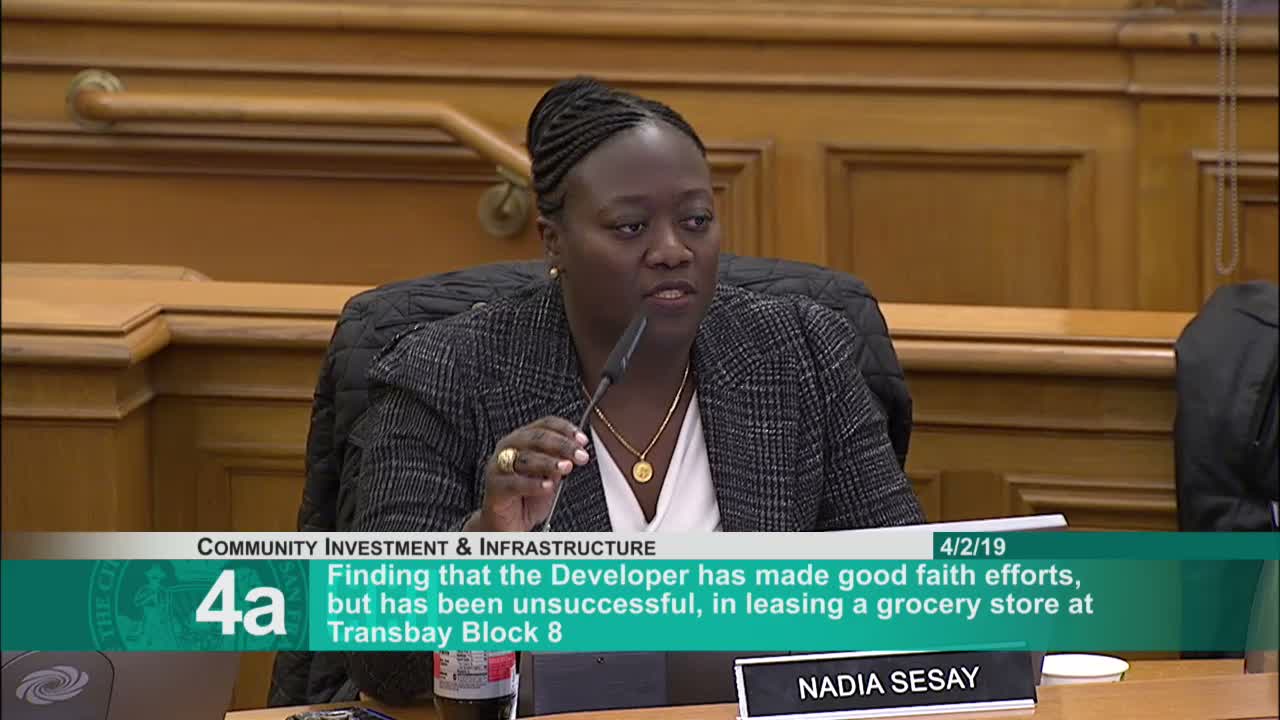
The Commission on Community Investment and Infrastructure voted 3–2 on April 2 to release Related California and partners from a contractual requirement to deliver a grocery at Transbay Block 8, after staff concluded the developer made required good‑faith leasing efforts under section 9.07 of the DDA.
The Commission on Community Investment and Infrastructure voted 3–2 on April 2 to terminate a developer’s contractual obligation to deliver a grocery at Transbay Block 8, concluding Related California and its partners had made the good‑faith leasing efforts required under section 9.07 of the disposition and development agreement (DDA).
OCII staff recommended the release after a multi‑year effort by the developer to market the roughly 12,400–17,600 square feet of retail space planned at Folsom Street between First and Fremont. Shane Hart, OCII’s project manager for Transbay, told commissioners the developer engaged retail brokers, met repeatedly with the Transbay Community Advisory Committee and East Cut Community Benefit District, offered below‑market rent and increased tenant‑improvement allowances, and contacted a broad list of national and local operators. "The developer has made good efforts as required in the DDA," Hart said during the presentation.
Related California’s team and partners described their outreach and the site’s constraints. Bill Witty, a Related representative, said market conditions and the space’s split‑level basement layout, lack of contiguous ground‑floor frontage and limited parking repeatedly deterred operators. "We didn't oppose the notion of having a grocer," Witty said, adding that several factors beyond the developer’s control—nearby Woodlands Market’s opening, rising operating costs and the Transbay terminal’s leasing delays—reduced interest.
Katie Lamont of the Tenderloin Neighborhood Development Corporation recounted a similar campaign at TNDC projects: many operators seek roughly 20,000 square feet and parking, and smaller sites often require substantial tenant improvements and operating certainty to justify investment. She described TNDC’s pivot toward local operators and programs that subsidize build‑out when feasible.
Public commenters were divided. Peter Hartman, a member of the Transbay CAC who voted for release at the CAC, said the developer had met the DDA’s good‑faith standard. CAC member Katrina Johnson urged the commission to keep pressing for an affordable neighborhood grocer and cited an East Cut CBD survey in which she said "85% of residents are interested or very interested in having another grocery store in the neighborhood." Ace Washington and other speakers urged the commission not to block the project and noted Related’s investments in the area.
Commissioners debated options before the vote. Commissioner Rosales questioned whether the development’s design sufficiently accommodated a grocer and whether the commission should delay approval to seek additional options from planning or the Transbay terminal. OCII’s general counsel cautioned that section 9.07 limits the commission’s authority to conditions directly related to whether the developer made good‑faith efforts to secure a grocery and that the commission must avoid imposing unrelated conditions that could be seen as unreasonable under the contract’s standard.
Commissioner Bustos moved to approve staff’s recommendation to lift the grocery requirement and asked staff to follow up with planning and other city partners; Commissioner Scott seconded. On roll call the motion carried, 3–2 (Yes: Scott, Singh, Bustos; No: Rosales, Madam Chair Mondahar). The commission approved resolution 4‑20‑19 to terminate the obligation under section 9.07 of the DDA.
The commission’s action removes the contractual grocery requirement, allowing Related to market the ground‑floor retail to neighborhood‑serving alternatives (staff and the developer said they would prioritize food‑and‑beverage and other uses that serve residents rather than 9–5 office populations). Commissioners who supported the vote said they would pursue further conversations with the city’s planning department and other agencies to seek citywide approaches for retaining or attracting affordable grocery options as neighborhoods change; commissioners opposed to the release said the commission should keep working to secure a grocer or a narrow, grocery‑like use before lifting the contractual obligation.