Get Full Government Meeting Transcripts, Videos, & Alerts Forever!
Get email alerts on the Unauthorized Demolition topic
No spam. Unsubscribe anytime.
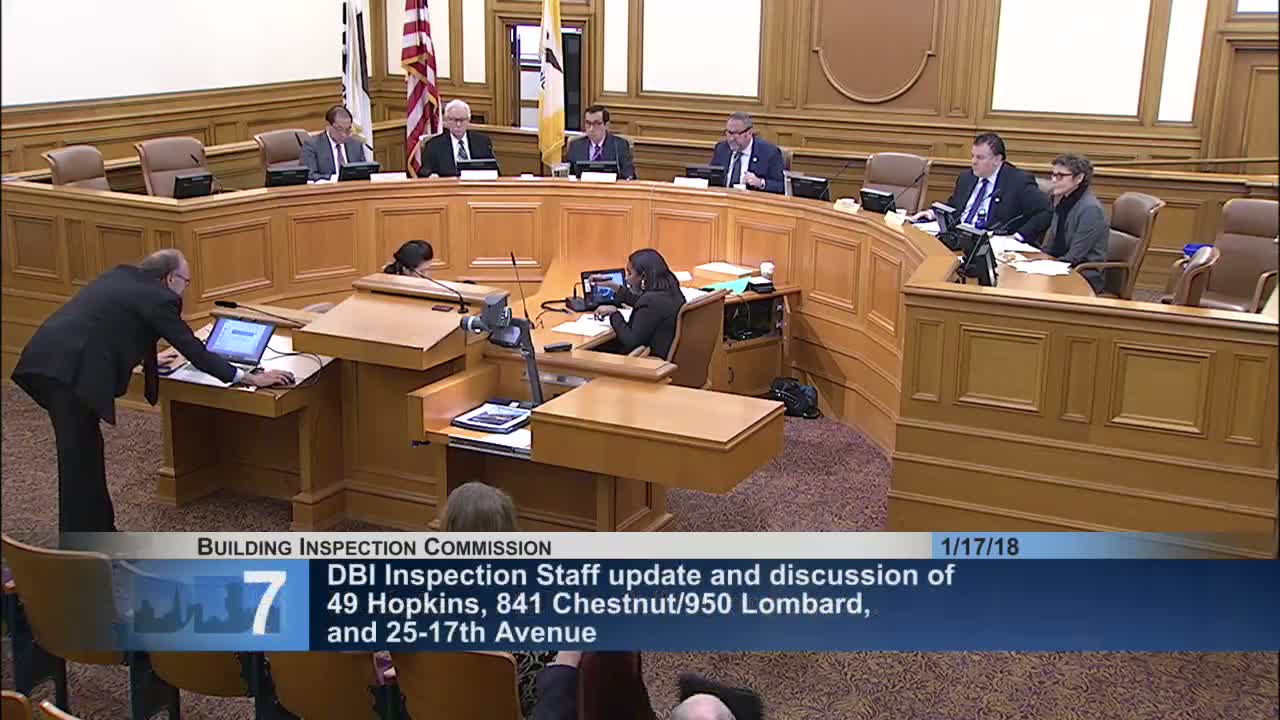
Neighbors, inspectors and DBI press for tougher enforcement after series of unauthorized demolitions
Summary
DBI staff and neighbors detailed multiple cases of demolition beyond approved permits, citing examples including 49 Hopkins, 841 Chestnut (950 Lombard) and 25 Seventeenth; the commission asked DBI to draft procedural changes, pursue joint meetings with Planning and explore stronger penalties and mandated pre-construction inspections.
Patrick O’Reardon, DBI’s inspection staff lead, told the Building Inspection Commission that the department has encountered a small but serious set of projects where demolition exceeded approved permit scope, leaving neighbors exposed to blight and structural risk. "We stop the work as soon as they are identified," O’Reardon said, but he added that current penalties—typically twice the valuation for work beyond a permit and nine times when there is no permit at all—often fall short as a deterrent for large projects where fines are a small fraction of value.
Several public speakers described sustained neighborhood harm. Mary Anne Bockers, whose home borders 310 Montcalm Street, said the developer bought the adjacent property and within weeks violated a settlement by undermining an uphill neighbor’s foundation and erecting a 400-square-foot, unpermitted third floor. "The property has multiple abatement orders against it," Bockers said, adding repair costs could exceed $200,000.
DBI and senior inspectors walked the commission through common patterns: misalignment between architectural drawings submitted to Planning and later structural addenda, contractors or subcontractors who begin shoring or foundation work without scheduling start-of-work inspections, and a complaint-driven enforcement model that often waits until demolition is visible. Senior inspector Joe Duffy said the agency typically issues a stop-work order, secures the site, and refers matters back to Planning, where projects can remain under review for years. "Sometimes there's tears involved," Duffy said of owners who learn their project has been stopped after work already removed significant building fabric.
Speakers from neighborhood groups and preservation organizations urged more aggressive remedies: registry and tracking of repeat offenders, higher monetary penalties, suspension or revocation of licenses for serial violators, and a clearer, harmonized definition of "demolition" between DBI and Planning. Gerry Dreutler and others presented examples they said showed serial misconduct by particular developers and engineers and urged referrals to state licensing boards where appropriate.
Director Tom Hui told the commission DBI will prepare an interim information sheet for applicants explaining how to present demolition scopes and which elements must be shown on plan sets; he also committed to stronger coordination with Planning staff. Hui cautioned that proving intentional misrepresentation for state discipline is complex but said DBI will return with concrete policy and procedural recommendations in the coming weeks.
Commissioners agreed on near-term steps: request a joint meeting with the Planning Commission this year, develop clearer plan presentation standards for permit applicants, evaluate feasibility of mandated start-of-work inspections for higher-valuation permits, and consider whether the department needs dedicated enforcement staff or legislative changes to make penalties more meaningful. The discussion generated no immediate binding code changes at the meeting but set clear deliverables for DBI staff to return with.