Get Full Government Meeting Transcripts, Videos, & Alerts Forever!
Get email alerts on the Rops 19 20 topic
No spam. Unsubscribe anytime.
OCII reviews ROPS 2019–20; staff outlines $403.7M plan, new bond issuances and program priorities
Summary
OCII staff presented the Recognized Obligation Payment Schedule (ROPS) for July 2019–June 2020, detailing a $403.7M plan, two proposed new bonds ($25.3M housing, $15.3M infrastructure), and $132.5M in affordable housing allocations; the item was informational and no commission vote was required.
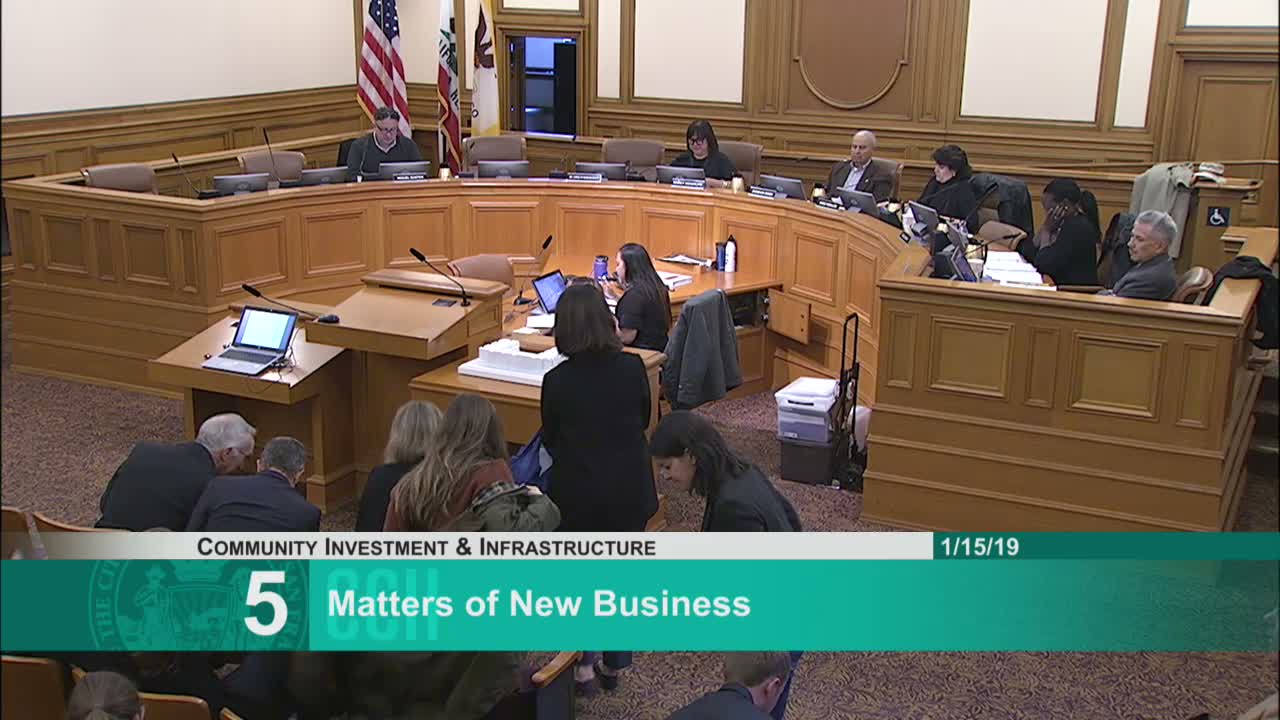
OCII commissioners received an informational workshop Jan. 15 on the Recognized Obligation Payment Schedule (ROPS) for July 1, 2019 through June 30, 2020. Mina Yu, financial reporting and management analyst, presented ROPS 19–20 and answered commissioner questions on funding sources, bond plans and community‑benefit allocations.
Yu said ROPS 19–20 totaled $403.7 million with five funding buckets: bond proceeds, reserve funds (due‑diligence balances), developer payments/grants/other funds, RPTTF non‑admin (redevelopment property tax trust fund for enforceable obligations), and RPTTF admin (administrative cost allowance). She said the largest component is bond proceeds and that an anticipated year‑over‑year decline reflects spending down infrastructure and changes to OCII's affordable housing pipeline.
Key allocations included a $132.5 million affordable housing program (with $91.2 million earmarked for gap loans including Mission Bay South Block 9 and Hunters Point Shipyard projects), $21.8 million in pre‑development loans for seven projects, and $13.8 million in housing pledge fund balance. Yu also outlined two proposed new bonds in fiscal 2019–20: a $25.3 million housing bond and a $15.3 million infrastructure bond. OCII's overall bond program was reported as $118.5 million.
On operating costs, Yu listed an $18.6 million administrative budget (funded largely by RPTTF non‑admin and developer fees), 54 FTEs, $9.6 million in salaries and benefits, $3.9 million in retirement obligations and $5.1 million in non‑labor costs. She also described $3 million in work orders with city partners for affordable housing services, audits, design and legal support.
Commissioners asked technical questions about bond interest rates, tax status and specific line items. Deputy Director of Finance Breema Hoarder explained that each bond has different interest rates set at issuance and that OCII uses both tax‑exempt and taxable bonds (tax‑exempt for infrastructure reimbursements and taxable for certain housing financings). Yu said the agency's outstanding bond portfolio in aggregate was reported at slightly more than $900 million.
Commissioners also pressed for more detail on community benefits and Hunters Point allocations; staff said the ROPS slides provided high‑level figures and committed to providing a deeper breakdown and the Legacy Foundation/Implementation Committee reports that outline how flexible and fixed community benefits are managed.
The ROPS workshop was informational; the commission did not take action and staff will return with the formal ROPS submission and any requested detail before the Feb. 1 submission deadline to the Department of Finance.