Get Full Government Meeting Transcripts, Videos, & Alerts Forever!
Get email alerts on the Accessible Business Entrance topic
No spam. Unsubscribe anytime.
DBI outlines Accessible Business Entrance program, sets phased deadlines and workshops
Summary
DBI staff presented the Accessible Business Entrance program created under a 2016 ordinance; outreach included a 12,400-mailer and web materials, with the first compliance forms due May 23, 2018 and workshops starting Jan. 24, 2018. Commissioners pressed staff on merchant outreach and language access.
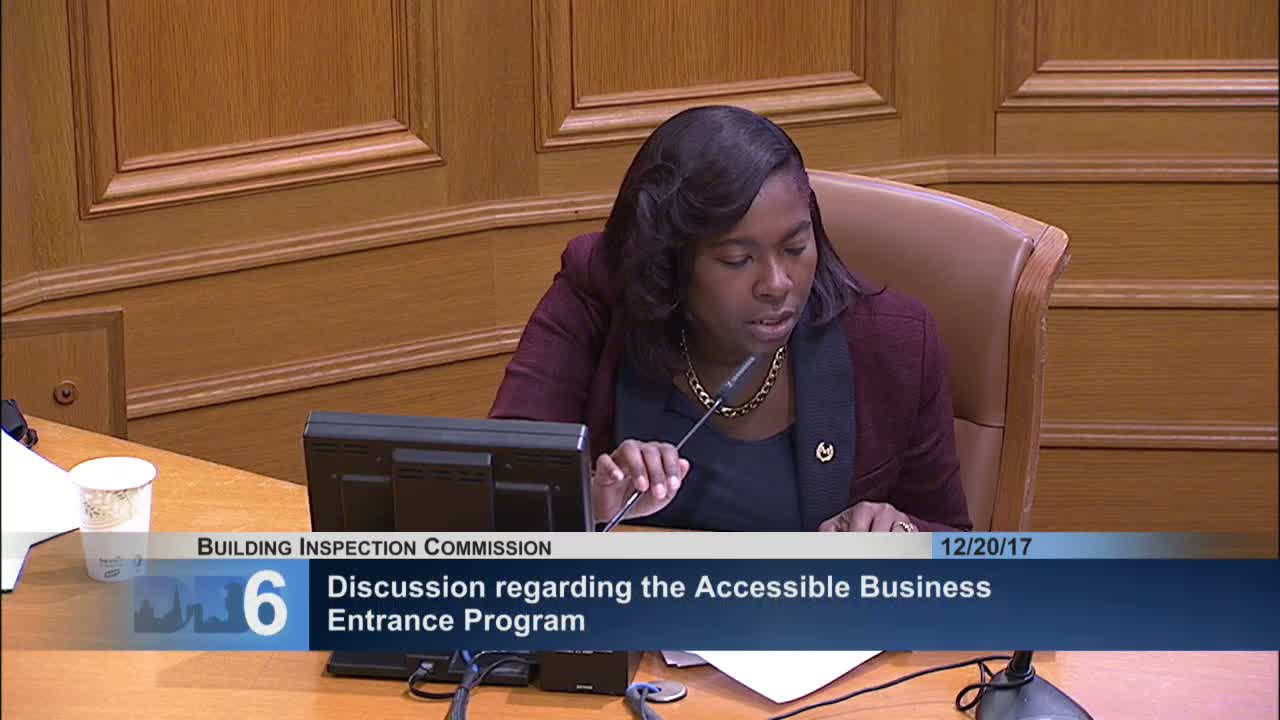
San Francisco — The Department of Building Inspection on Dec. 20 outlined a multi-year Accessible Business Entrance (ABE) program intended to increase accessibility at commercial storefronts and to reduce litigation against small merchants.
Bill Strachan, Legislative and Public Affairs for DBI, said the program implements an ordinance sponsored by Supervisor Kitty Tang and is structured into four categories with staggered compliance deadlines. “We sent a mailer to about 12,400 property owners and our records staff identified roughly 27,000 properties that may be included,” Strachan said. He said the first compliance-related documents are due May 23, 2018, with later deadlines through Nov. 23, 2019, and that permit and construction timelines could extend as far as 2021 for some properties.
The program includes outreach and exemptions: property owners who believe they are exempt can self-certify using an online affidavit, and staff plan a Jan. 24 workshop at DBI’s 1660 Mission office for property owners. Strachan said DBI will use paid advertising, bilingual materials and a hotline (415-558-6128) to reach owners and tenants and that staff will coordinate with Public Works, the mayor’s office on disability, and the Small Business Commission.
Commissioners pressed staff on easing burdens for small merchants, language access and use of merchant networks. Vice President Walker urged outreach through neighborhood business organizations and merchant associations; Strachan said DBI would coordinate with local merchant groups and explore using business-license renewal contacts. Commissioners also asked whether certified access specialists (CASP) would be required; Strachan said architects or engineers could perform necessary reviews because of a limited local CASP pool.
The commission did not take formal action on the item. DBI indicated it will return with further updates and outreach plans, and will schedule additional briefings to explain screening forms, exemptions and the appeals process.