Get Full Government Meeting Transcripts, Videos, & Alerts Forever!
Get email alerts on the Tall Buildings topic
No spam. Unsubscribe anytime.
DBI lays out stricter peer review, 10-year settlement monitoring for tall buildings
Summary
DBI told the Building Inspection Commission it has issued interim guidelines (S-18) and is revising tall-building rules (AB082/AB083) to broaden peer review, require annual settlement monitoring for 10 years after occupancy, and create a city-retained pool of reviewers funded through developer cost recovery.
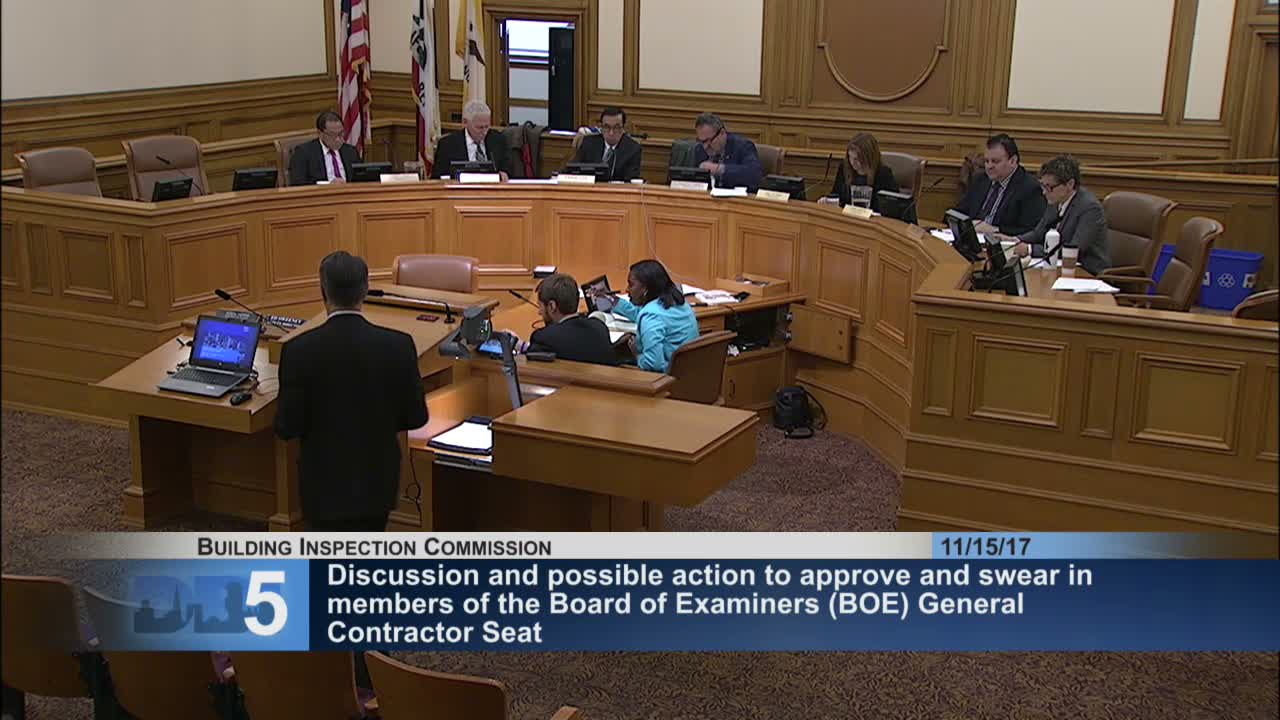
San Francisco City Department of Building Inspection officials briefed the Building Inspection Commission on Nov. 15 on interim measures and rule changes aimed at tightening safety reviews for new tall buildings.
Assistant Director Ron Tom described the interim guidelines (information sheet S‑18) and proposed improvements to administrative bulletins AB082 and AB083, saying the revisions would broaden the review beyond structural design to include geotechnical and seismic-hazard mitigation. "These are complex structures, and, we've been making the effort to improve their building safety," Tom said.
DBI said S‑18 would require annual settlement-monitoring data to be submitted to DBI for 10 years after a certificate of final completion (CFC) or temporary certificate of occupancy (TCO) is issued. Director Tom Hui told commissioners the department will record monitoring requirements with the assessor's office or by including a special restriction on title and will pursue notices of violation (NOVs) for noncompliance.
To support the expanded review, DBI reissued a request for qualifications (RFQ) to assemble a prequalified pool of experts. DBI said the RFQ was reposted Oct. 30 with submissions due by Jan. 5, 2018, and that staff expect to issue a prequalified list after February 2019. DBI told the commission the current pool contains about 16 structural engineers, "7 or 8" geotechnical engineers and 4 academic reviewers, and the city wants a deeper pool to ensure coverage across disciplines.
Commissioners pressed staff on implementation details: how monitoring data will be received, who will enforce missing reports and which office will trigger follow-up action. Tom Hui described an annual submission and file-record system, said DBI will ask a building owner's geotechnical consultant to re-review work if settlement appears substantial, and said the department will issue correction notices or NOVs when required.
DBI also described changes to the peer-review process: peer reviewers will be selected and appointed by DBI rather than by developers, and panels for high-risk projects (for example projects on soil class F or clustered projects in a liquefaction-prone area) may include multiple geotechnical reviewers. Tom Hui emphasized the review is intended to evaluate the developer's submittal, not to assume design responsibility for the project.
On how the city will pay for reviewers, DBI said it has asked Supervisor Peskin to schedule a Land Use Committee hearing to allow cost recovery so the city can hire reviewers and pass those costs to developers. Deputy City Attorney Rob Capla told commissioners that, while the city would retain and pay experts initially, developers would ultimately bear the costs and remain professionally responsible for the design.
Why it matters: DBI officials said the package is intended to reduce risk in San Francisco's complex soil and seismic environment by improving independent review, documenting design-review processes and ensuring post-occupancy monitoring. Commissioners asked DBI to provide written details of enforcement triggers and to return with a progress update in January 2018 when SEANC task‑force recommendations are expected to be finalized.
The commission did not adopt new ordinances at the meeting; DBI staff signaled parallel actions (RFQ outreach, S‑18 interim controls and coordination with the Land Use Committee) and the department will report back with finalized recommendations and implementation steps.