Get Full Government Meeting Transcripts, Videos, & Alerts Forever!
Get email alerts on the Ocii Budget 2018 19 topic
No spam. Unsubscribe anytime.
OCII previews $747.6 million budget for 2018–19, emphasizes affordable housing loans and debt service
Summary
Deputy finance staff presented OCII’s proposed FY 2018–19 budget of $747.6 million emphasizing $220.3 million in new affordable housing loans, continued development reimbursements and major project budgets for Shipyard, Mission Bay and Transbay.
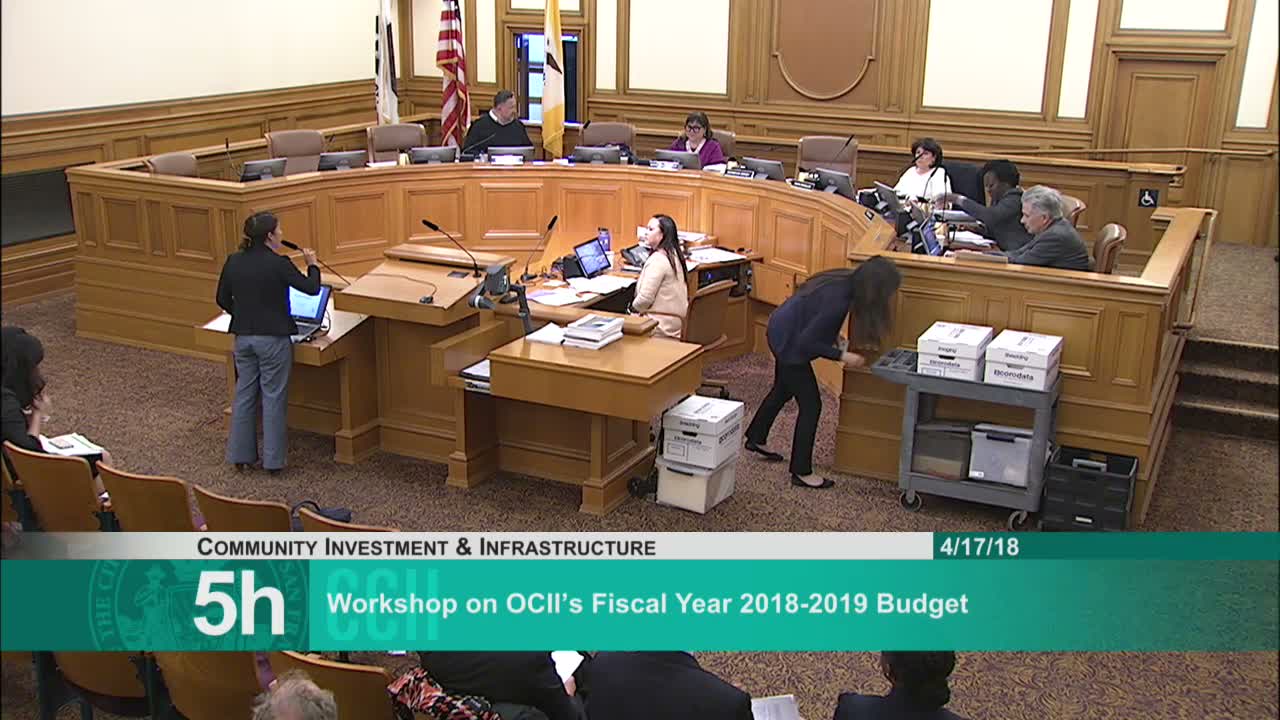
At a workshop on April 17 the Commission on Community Investment and Infrastructure reviewed OCII’s proposed fiscal year 2018–19 budget totaling $747.6 million and discussed the agency’s anticipated uses and funding sources.
Deputy Director of Finance and Administration presented the agency’s funding plan: primary sources include prior period authority, new bonds and property tax; primary uses are affordable housing loans (staff proposed $220.3 million in new loans), development infrastructure reimbursements and debt service. The draft operations budget was $16.3 million (including $8.6 million for salaries and benefits and $3.5 million for retiree pension and health payments), and staff said the operating budget reflected 55 full‑time equivalents plus two limited‑term positions converted to FTEs.
Project budgets and pipeline: Staff outlined project‑area budgets: Shipyard $170.9 million (largely planning and design, developer reimbursed), Mission Bay combined north and south roughly $263 million (mature project requiring bond issuances and public‑space construction) and Transbay $125.9 million (funds in part from a larger development fee fund balance). The affordable housing workplan anticipated moving 2,622 units through the pipeline next year (516 predevelopment, 720 gap finance, 706 in construction, 680 completions).
Questions and public comment: Commissioners asked about sources to cover operating costs not covered by the statutory administrative cap (ACA), parking and implementation oversight, and workforce training timing. In public comment Oscar James and others urged use of housing resources for veterans, homeless residents and returning citizens; Ace Washington requested follow‑up on Fillmore area initiatives.
Next steps: Staff said the presentation would be refined after commissioner feedback and OCII would return May 1 for commission action to forward the budget to the mayor’s budget office and the Board of Supervisors in the usual process.