Get Full Government Meeting Transcripts, Videos, & Alerts Forever!
Get email alerts on the Land Use Taxation Cfd topic
No spam. Unsubscribe anytime.
Commission adopts ordinance allowing special taxes for Hunters Point Shipyard/Candlestick Point CFD No. 9
Summary
The commission adopted the second‑reading ordinance to levy special taxes in Community Facilities District No. 9 (Hunters Point Shipyard/Candlestick Point). Staff said taxes would fund public infrastructure and services, authorize bonding, and include a facilities tax (up to 75 years) and a perpetual services tax indexed to CPI or 5%.
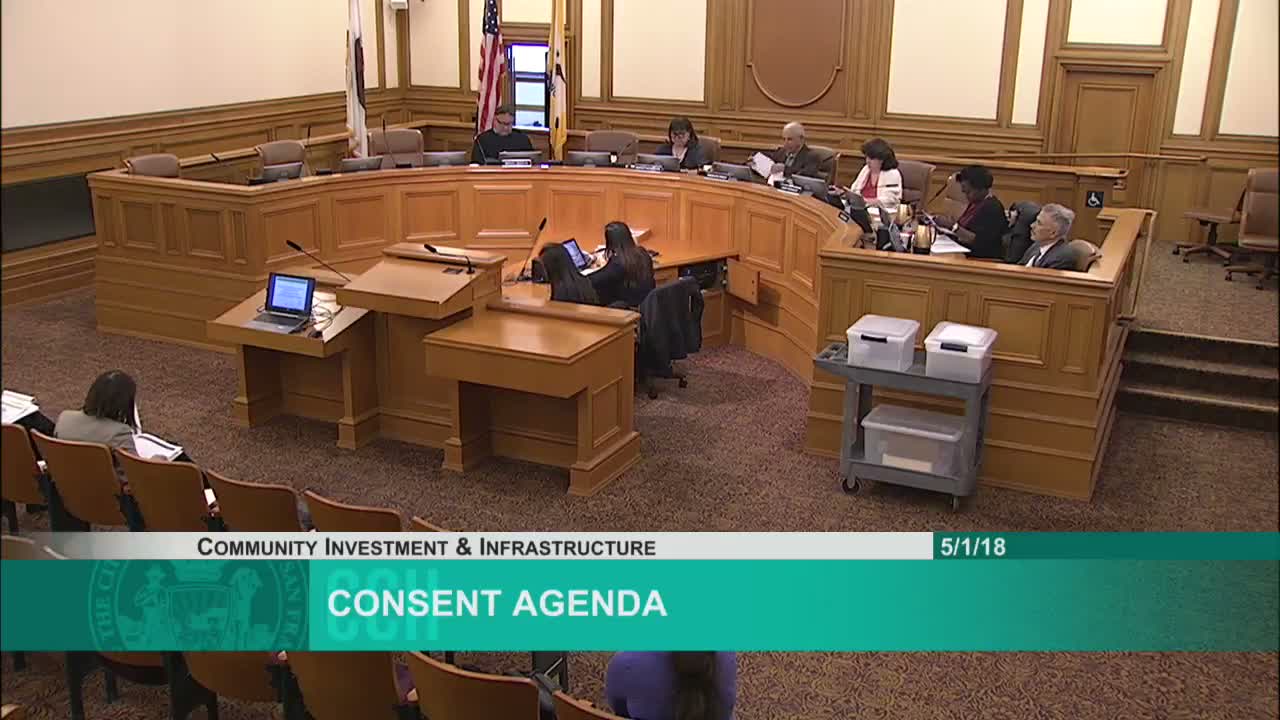
The Commission on Community Investment and Infrastructure voted unanimously May 1 to adopt an ordinance (second reading) authorizing the levy of special taxes in Community Facilities District No. 9 for phase 2 of Hunters Point Shipyard and Candlestick Point.
Bree Mahorter, who identified herself in the meeting as the deputy director for finance and administration, told commissioners that the commission had previously set the CFD boundaries and approved the rate and method of apportionment. She said the ordinance before the commission would authorize the levy of a facilities tax and a services tax to fund public infrastructure and services consistent with the disposition and development agreement (DDA) and the financing plan.
According to staff, the facilities tax term would not exceed 75 years and would vary by property type; the services tax would be levied in perpetuity and escalate by the lesser of the Consumer Price Index for the San Francisco‑Oakland‑San Jose region or 5 percent. Staff also described a bonded indebtedness limit and specific limits for improvement area 1 that were part of prior resolutions establishing the CFD.
Chair Mary Lee Wandaher closed public comment after staff presentation when no speaker cards were submitted. Commissioner Bustos moved to adopt the ordinance; Commissioner Singh seconded. A roll call recorded four ayes (Rosales, Singh, Bustos, Chair Mondahar) and the ordinance was adopted.
Staff presented the ordinance as the final procedural step in formation of the CFD, following a prior special election and a sequence of formation resolutions. The ordinance authorizes taxation for the described improvement area and also provides mechanisms for annexing future improvement areas subject to the rate and method of apportionment or a separate annexation process.
Questions and detailed implementation steps (including final bond sizing, timelines for tax levies, and final property‑level rates) were not resolved during the meeting; staff said those elements are governed by prior resolutions and the financing plan and would be addressed as appropriate in subsequent proceedings.