Get Full Government Meeting Transcripts, Videos, & Alerts Forever!
Get email alerts on the Infrastructure Resilience topic
No spam. Unsubscribe anytime.
San Francisco reviews PG&E public-safety power-shutoff risks and cross-department readiness
Summary
Council members heard city-run exercises and cross-department coordination plans for PG&E's PSPS program, which could leave San Francisco without power for 24 hours or longer if Peninsula or East Bay transmission lines are de-energized; staff outlined continuity, fuel and communications challenges and follow-up with private-sector and CBO partners.
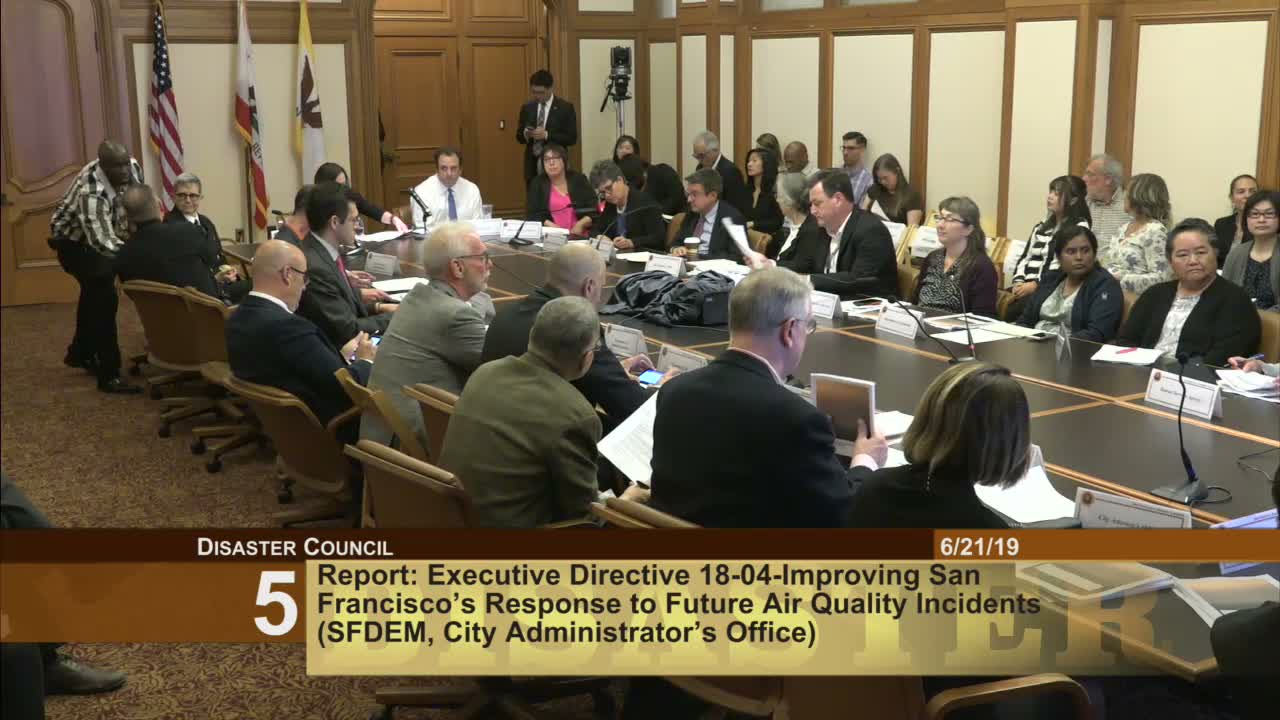
San Francisco officials briefed the Disaster Council on planning and exercises related to Pacific Gas & Electric's public-safety power shutoff (PSPS) program. Staff said the California Public Utilities Commission approved PSPS guidelines that allow de-energizing transmission and distribution lines in high-risk conditions to reduce wildfire starts; because San Francisco's transmission lines connect via higher-risk East Bay and Peninsula corridors, a PSPS could produce sustained outages in the city.
Director Carroll and workshop leads described a cross-department exercise convening more than 120 participants to identify impacts and next steps. "The power outage will affect everyone, and our ability to perform city services," staff said, noting impacts on public safety, health systems, communications (cell and data networks), traffic signals, transportation and staffing. They warned that outages could last at least 24 hours and possibly much longer and that recovery may take additional time beyond power restoration for data systems and services to return to normal.
Bijan Creamy (acting deputy director for emergency services) summarized three objectives of the exercise: estimate potential impacts, improve interdepartmental information-sharing and develop future preparedness actions. Staff noted dependencies on fuel for vehicles and generators, the need to cross-train staff and to reassess continuity-of-operations plans. They also discussed possible short- and medium-term investments such as solar and storage and stronger coordination with private-sector vendors and community-based organizations.
During public comment, Nick McCoy asked staff to quantify a worst-case scenario, including potential numbers and evacuation or large-scale escape strategies; staff thanked him and invited ongoing participation in follow-up workshops.
No formal action was taken; staff signaled additional workshops with private-sector partners and CBOs in July and continued planning work over the summer.