Get Full Government Meeting Transcripts, Videos, & Alerts Forever!
Get email alerts on the Heat And Air Quality Response topic
No spam. Unsubscribe anytime.
City reports inventory of public cooling/clean-air sites and launches regional air-quality messaging toolkit review
Summary
San Francisco officials briefed the Disaster Council on an inventory that narrowed 1,765 public facilities to 143 candidates for near-term cooling or cleaner-air activation, outlined next steps to define respite center protocols and announced a regional Bay Area air-quality messaging toolkit open for public review through July 22.
City staff told the Disaster Council they completed an initial inventory and a set of practical next steps to improve responses to heat and air-quality emergencies.
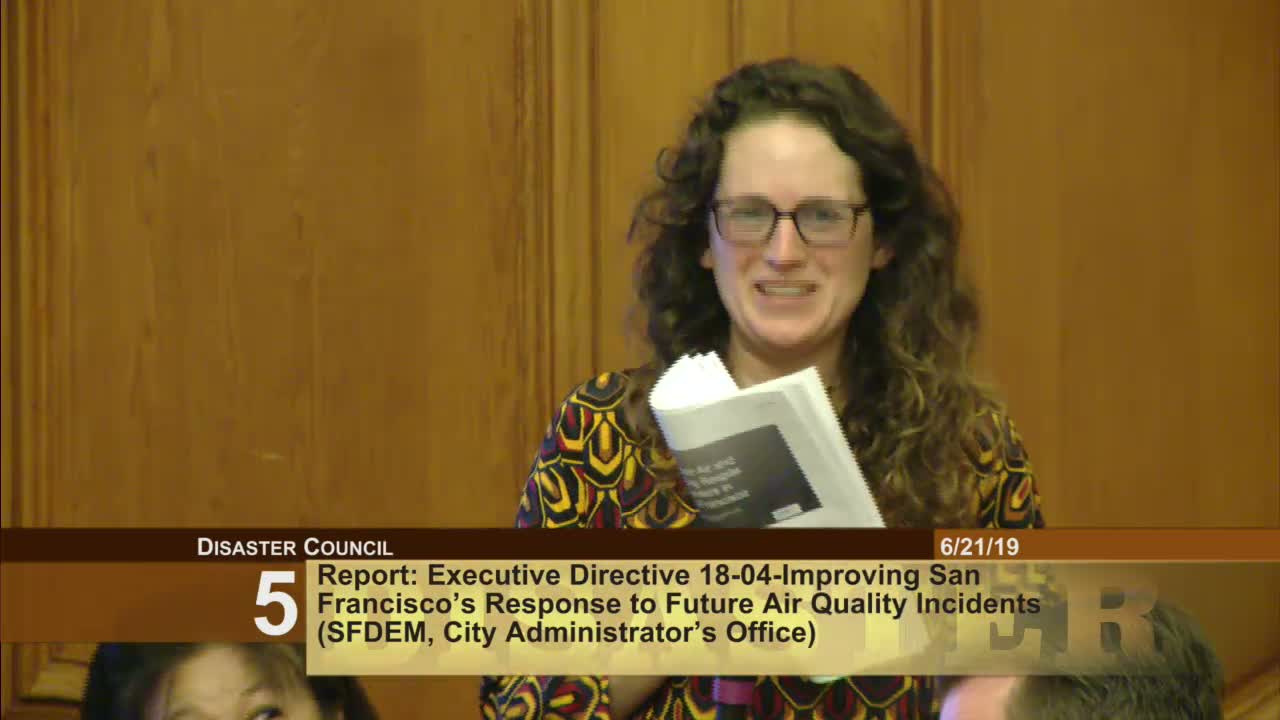
Heather from the Mayor's Office said her team consolidated three city facility datasets to identify buildings that could serve as cooling or clean-air respite centers. "That gave us 1,765 buildings," she said, and after screens that excluded private sites, very small buildings and facilities without HVAC systems, the city reduced the set to 143 public facilities for a short-list of candidates.
Heather said the city also relied on facility managers and subject-matter experts to vet which buildings could be activated quickly and where modest investments (portable air conditioners or air scrubbers) would have the most impact. Libraries and cultural centers were highlighted among cleaner-air candidates; public pools and museums were noted as valuable cooling resources but not well-suited for cleaner-air activation.
On regional messaging, Francis Zamora (DEM) presented a draft Bay Area Regional Air Quality Messaging Toolkit developed with public information officers, the Association of Bay Area Health Officers and the Bay Area Air Quality Management District. Zamora said the toolkit includes core templates (FAQs, press releases, short and long messages and social posts) organized by audience and was tested in a regional tabletop exercise. The toolkit will be open for comment through July 22; a final draft will be posted in early August and translated into threshold Bay Area languages.
Next steps identified by staff include: defining respite-center service levels and operational protocols; conducting detailed facility assessments for future investments; planning a one-time procurement of portable equipment for rapid activation; developing a co-led DPH-DEM communications and training plan; and pursuing partnerships with private facilities where appropriate. Heather cautioned that installing comprehensive HVAC upgrades would be a multi-million-dollar effort and that the city must balance investments against other needs.
The council did not adopt any new policy at the meeting; staff said the inventory, the toolkit review and procurement planning will continue over the summer.