Get Full Government Meeting Transcripts, Videos, & Alerts Forever!
Get email alerts on the Vacant Property Enforcement topic
No spam. Unsubscribe anytime.
Abatement Appeals Board upholds orders for two Ocean Avenue storefronts, gives short deadline to register
Summary
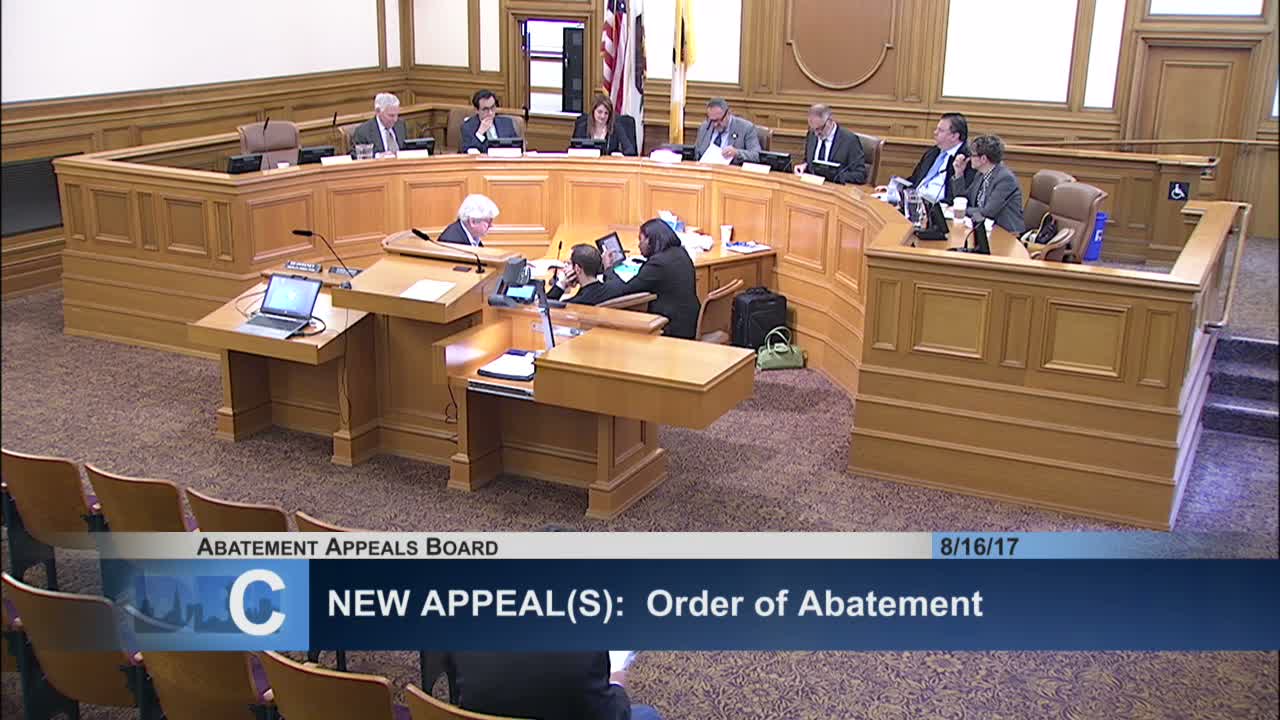
The San Francisco Abatement Appeals Board on Aug. 16 denied appeals from owner Sophie Lau for two Ocean Avenue storefronts, upheld orders of abatement and assessed costs, while giving limited time for owners to register or verify occupancy under the vacant‑property rules.
SAN FRANCISCO — The Abatement Appeals Board unanimously denied appeals and upheld orders of abatement for two commercial storefronts at 1941 and 1945 Ocean Avenue on Aug. 16, finding the properties had not completed required vacant‑property registrations or paid the associated fees after notices issued in 2015.
The board’s action stems from code enforcement presentations that the two storefronts were cited under San Francisco’s vacant and abandoned commercial‑storefront program after a first notice dated March 18, 2015, and a second notice dated May 1, 2015. Michael Ganell, code‑enforcement staff with the Department of Building Inspection, told the board that 1941 Ocean remains out of compliance despite an over‑the‑counter permit receipt from Dec. 23, 2016, and that the department had not received a completed registration and payment required to close the violation.
“At this point, the property still remains out of compliance,” Ganell said, describing repeated neighborhood complaints and staff follow‑ups. The department explained that a filed permit number alone did not constitute a complete registration and that the vacant‑commercial‑storefront program allows a delayed payment window, while the vacant‑building rules require more immediate registration.
Owner Sophie Lau, identified in the record as the appellant and owner of the four‑unit building that includes 1939–1945 Ocean Ave., told commissioners she has been working with insurance, architects and contractors after a nearby fire and that delays prevented quicker repairs and leasing. Lau said she provided a lease and a rent check for 1945 to department staff and had paid a monitoring fee for some units.
“I went there, talked to them, and one of the [code enforcement] staff agreed that I had already leased the store,” Lau said, asking the board to reverse the abatement and waive fees. Commissioners pressed Lau on why the property had not been registered during the two‑year window following the initial notice; several members emphasized that registration—not proof of an immediate tenant plan—is the compliance requirement that resolves a notice of violation.
Commissioners also focused on program timelines and fees. Ganell told the board stakeholders have 270 days (about nine months) from the date of a violation to complete payment for vacant commercial‑storefront registration; however, inspections in mid‑2016 showed no payment had been received for the properties at issue. Commissioners said registration typically requires a completed form plus documentation such as a lease and, where helpful, utility bills or other proof of occupancy for removal from the vacant list. The interim assessment for one order was cited at about $1,400, and commissioners noted the annual monitoring/registration fee is roughly $700.
Votes at a glance
• Case 68341941 (1941 Ocean Ave.): Motion by Commissioner Walker to deny the appeal, uphold the order of abatement, give 30 days to register as a vacant building and uphold assessment of costs; seconded and carried unanimously on roll call.
• Case 68351945 (1945 Ocean Ave.): Motion by Commissioner Walker to deny the appeal, uphold the order of abatement and assess costs; seconded by Vice President Gilman and carried unanimously on roll call.
Board members framed the ordinance as a community‑tracking tool. “This is a really important piece of legislation for us to be able to track vacant commercial spaces and help them get activated through various city programs,” Vice President Gilman said. Commissioner Warshall urged that filings help prevent blight in commercial districts and noted the ordinance’s role in community vibrancy.
Both sides acknowledged recent occupancy activity at one storefront end of the building. The department said it will verify occupancy to determine whether the active unit meets removal criteria; commissioners stressed that paying a penalty or later occupying a space does not erase the prior violation for the period it remained unregistered.
The board concluded public comment with no additional speakers, adjourned at 9:45 a.m. and scheduled a 15‑minute recess before reconvening as the Building Inspection Commission at 10:00 a.m.