Get Full Government Meeting Transcripts, Videos, & Alerts Forever!
Get email alerts on the Plan Check Performance topic
No spam. Unsubscribe anytime.
DBI says 92% of permits are handled over the counter; commissioners and engineers press for quality data
Summary
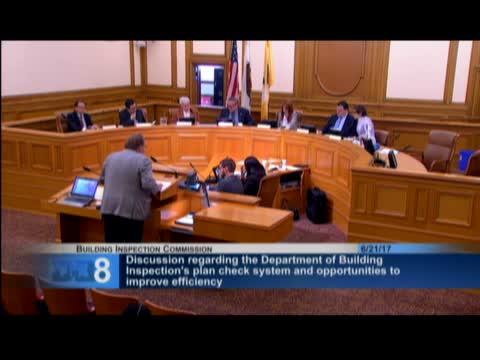
Deputy Director Dan Lowry described DBI plan-check performance — including a reported 92% over‑the‑counter permit rate and multiple turnaround benchmarks — prompting commissioners and structural engineers to press for consistency, enforcement metrics, and more granular data on errors and notice-of-violation outcomes.
Deputy Director Dan Lowry told the Building Inspection Commission that DBI reviews tens of thousands of permits each year and relies on a mix of over‑the‑counter reviews, supervisor spot checks and training to maintain consistency.
"In 2015 and 02/2016, 69,000 permits issued to DBI; DBI has a 92% over‑the‑counter review," Lowry said, and added performance benchmarks for high‑value site permits and multi‑family projects. He described internal quality-control practices including weekly manager meetings, biweekly code discussions and a 5% senior plan‑review spot‑check quota.
Commissioners pressed for more detail about apparent inconsistencies: why near‑identical site permits sometimes require different numbers of comment rounds or take substantially different lengths of time. Structural engineer David Bonowitz and other commenters said throughput numbers alone don’t show whether the work is being done correctly, urging DBI to publish enforcement metrics such as notices of violation and follow‑up results.
Lowry and Director Huey said DBI tracks backlog reports and performance goals for individual plan checkers and that managers review problem jobs weekly. Director Huey acknowledged limits in current time‑tracking and said staff are working on more consistent hourly reporting so the department can better analyze reviewer workload. Deputy director Lowry offered to produce additional reports and said staff routinely escalate issues to the planning group or code advisory committee when needed.
The exchange left commissioners seeking a short, regular follow-up report: several asked DBI to provide data on reviewer hours, distribution of comment rounds, NOVs and whether patterns link problems to particular contractor or reviewer profiles. Public commenters urged stronger enforcement and systematic channels for professionals to flag persistent quality problems.
Next steps: DBI committed to producing additional data and to consider management-level metrics to identify unusual deviations in plan-check throughput versus quality.