Get Full Government Meeting Transcripts, Videos, & Alerts Forever!
Get email alerts on the Affordable Housing Production topic
No spam. Unsubscribe anytime.
OCII reports a strong FY2016-17 for affordable housing; flags tax-reform financing risk
Summary
OCII staff reported delivery of 603 OCII-sponsored affordable units in FY2016-17, progress across Hunters Point/Candlestick, Mission Bay and Transbay, and a large pipeline; staff warned that proposed federal tax reform affecting private activity bonds could jeopardize tax-exempt bond financing used on many projects.
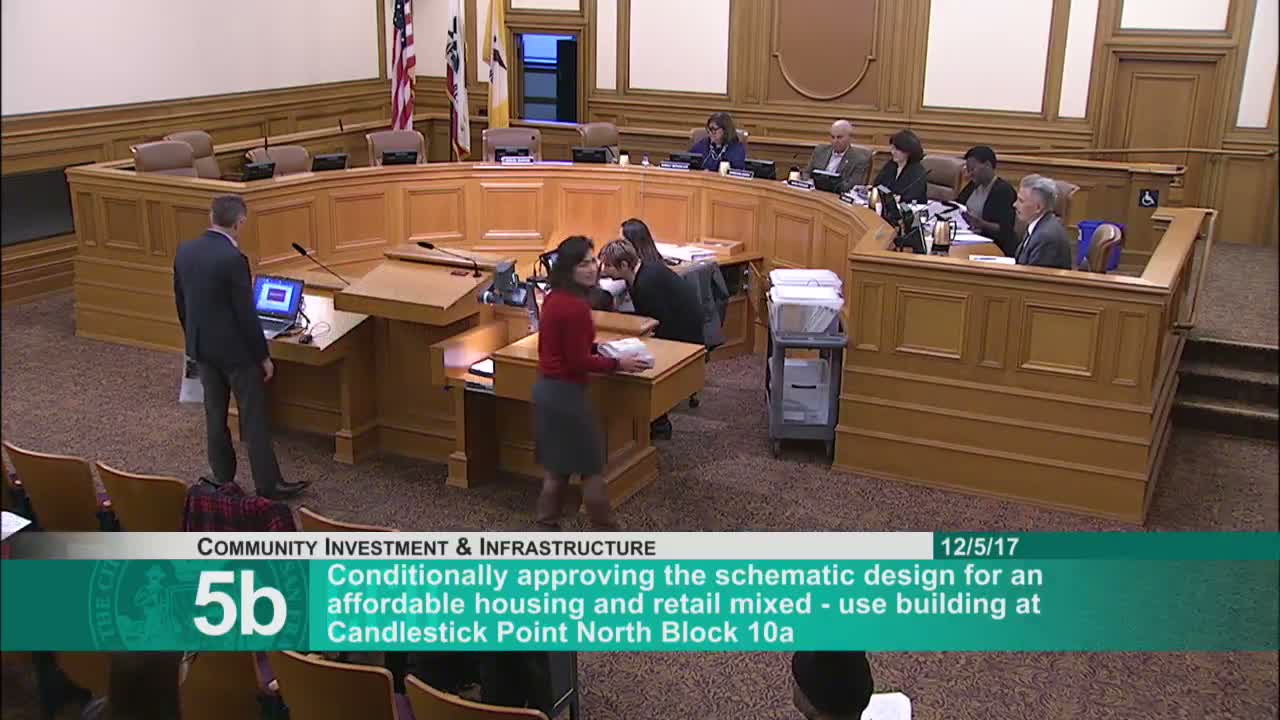
The Commission on Community Investment and Infrastructure received the agencys FY2016-17 affordable housing production report on Dec. 5, which OCII staff described as a strong year for delivery and pipeline development.
Jeff White, OCII housing program manager, told commissioners the agency delivered 603 OCII-sponsored affordable units in FY2016-17, including 552 OCII-funded standalone units and 51 inclusionary units. "We deliver in fiscal 16, 17, we delivered 603, OCII sponsored affordable units," White said. He noted OCII's role in meeting the Mayors housing goal and said the agency's housing obligations will yield nearly 3,000 affordable units by 2020, contributing about one-third of the citywide target.
White described a sizable pipeline: roughly 1,400 units were in construction or active predevelopment, with Alice Griffith phases delivered and additional phases underway, multiple Mission Bay and Transbay parcels in various stages, and planned RFPs for Transbay east and west blocks. He also highlighted local contracting results, reporting that in FY2016-17 about $433 million in professional services and construction contracts were awarded and that roughly 35.7% of that value went to small business enterprises (SBEs).
The presentation stressed a financing risk: White flagged proposed federal tax reform language that in the House bill would eliminate private activity bonds, a key source of tax-exempt bond financing and a mechanism to access 4% tax credits for many OCII projects. "Theres a big scramble right now with the deals that are using tax-exempt bond financing," he said, urging vigilance in the reconciliation process in Congress.
Commissioners asked clarifying questions about neighborhood-by-neighborhood performance, unit-type allocations (senior, family, supportive housing), marketing and COP (certificate of preference) outreach, and SBE participation. Members praised the tracking charts and asked for more maps and outreach context for neighborhoods such as the 40-acre Transbay redevelopment area.
Jeff White said OCII would continue issuing RFPs and returning to the Commission for approvals at key financing milestones. The report includes project-level metrics (Alice Griffith, Hunters View Phase 2A, Mission Bay completions and Transbay status) and notes implementation steps to transfer completed assets to the Mayors Office of Housing and Community Development (MOHCD) as appropriate.