Get Full Government Meeting Transcripts, Videos, & Alerts Forever!
Get email alerts on the Rops Budget topic
No spam. Unsubscribe anytime.
OCII presents $508.1 million ROPS for 2018–19, highlights more than $195 million for affordable housing
Summary
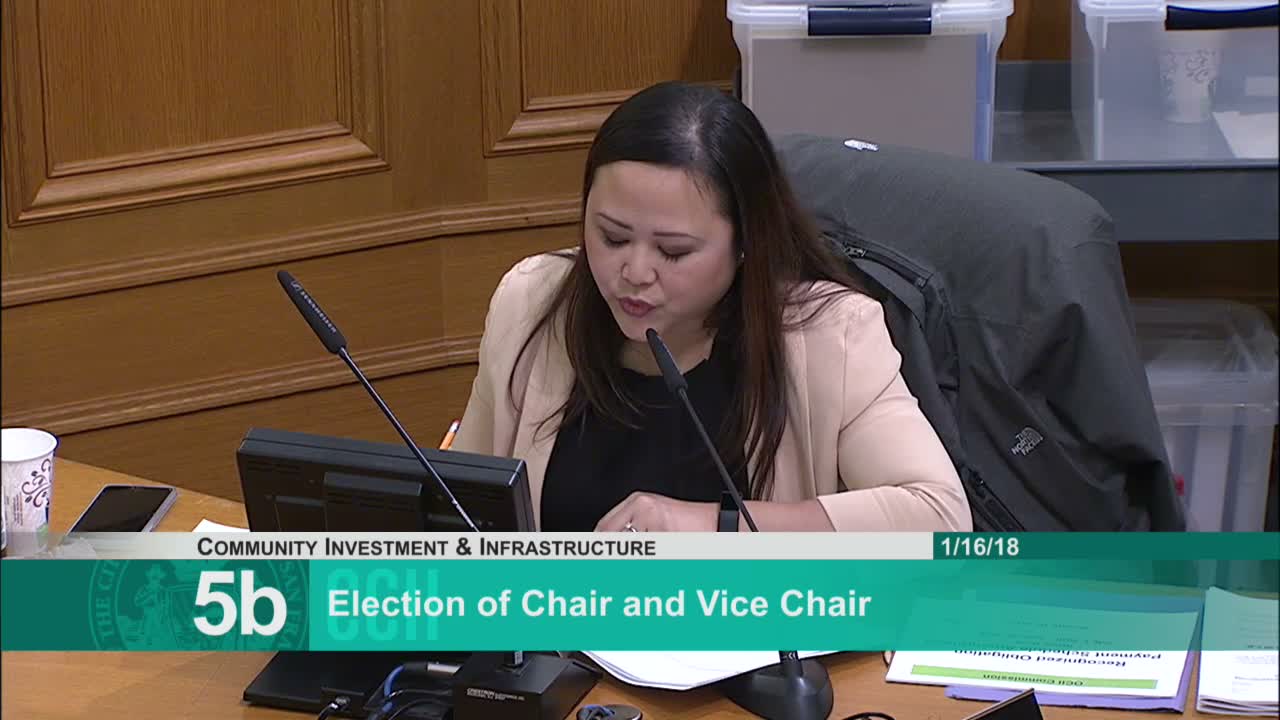
At a Jan. 16 OCII workshop, staff outlined a $508.1 million Recognized Obligation Payment Schedule for July 1, 2018–June 30, 2019 dominated by bond proceeds and earmarked largely for affordable housing loans and infrastructure reimbursements; the oversight board will consider the ROPS Jan. 22 before submission to the California Department of Finance on Feb. 1.
San Francisco — At a Jan. 16 workshop, OCII, the successor agency to the San Francisco Redevelopment Agency, presented a $508,100,000 Recognized Obligation Payment Schedule (ROPS) for fiscal year 2018–19 that staff said will be sent to the oversight board for approval Jan. 22 and then submitted to the California Department of Finance on Feb. 1.
Deputy Director for Finance and Administration Breema Hoarder said the ROPS is the agency's annual list of enforceable obligations and their funding sources. “In layman's language, what this means is it's a list of enforceable obligations, a list of payments that we need to make and their funding source for the fiscal year 18–19,” Hoarder said. She told commissioners the document reflects a major reliance on bond proceeds because the largest planned expenditures are infrastructure reimbursements and affordable housing loans.
Hoarder said the largest single expenditure line in 2018–19 will be affordable housing loans, with staff planning to spend more than $195,000,000 on loans that support project-area housing production. She presented a breakdown showing about 39% of the ROPS dollars as direct affordable housing loan expenditures plus roughly 12% in housing-related debt service, a combination the agency counts as putting more than half its budget toward affordable housing.
Staff described changes that reduced the agency's reliance on property-tax increment for non-administrative costs, citing recent bond refundings and favorable market interest rates on bond issuances. “Those refundings and market responses translated into lower debt service than we projected, which in turn reduces our use of property tax for non-admin costs,” Hoarder said.
Project managers gave area-by-area briefings. Tamsen Drew, senior project manager for Hunters Point Shipyard and Candlestick Point, said the Shipyard program will continue park openings and infrastructure work under development agreements with master developers and that federal grants (including an EDA award) require local matches. Mark Slutskin, Mission Bay project manager, said Mission Bay ROPS activity will reimburse the master developer (Fossil MB) for streets and parks work around the arena and cover professional review services. Shane Hart, Transbay project manager, outlined Folsom Street improvements, Transbay Park design and outreach, and negotiation of a Block 4 disposition and development agreement.
Elizabeth Colomello, senior development specialist, tied the ROPS spending to the mayor's affordable-housing production goal and showed project-area housing totals on staff slides: Shipyard/Candlestick (presented on slides as "5 42," interpreted as 542 units), Mission Bay ("3 77," interpreted as 377), and Transbay ("2 47," interpreted as 247).
Staff also reviewed operating budget constraints and long-term liabilities: an administrative cap set by law of roughly $4.6–$4.7 million, a total operating budget near $16.9 million, payroll and benefits for about 50 full-time staff, and annual payments toward pension and OPEB liabilities.
Commissioners pressed staff on the size and repayment of the debt portfolio. Hoarder said the agency's debt service portfolio is currently on the order of $900 million to $1 billion and that bond underwriting conservatively requires about 1.2 times coverage of projected debt service. She described the agency's practice of issuing long-term (commonly 30-year) debt and noted final payoff dates will depend on future issuance and repayment schedules.
The presentation closed with staff noting recent progress: the agency reported its first pledged property tax distribution for Shipyard 1 (more than $150,000) and said higher bond proceeds and lower debt service create capacity for additional affordable housing loans.
Next steps: OCII staff will incorporate commissioner feedback, present the ROPS to the oversight board on Jan. 22, and—if approved by the oversight board—submit the document to the California Department of Finance by Feb. 1.