Get Full Government Meeting Transcripts, Videos, & Alerts Forever!
Get email alerts on the Affordable Housing topic
No spam. Unsubscribe anytime.
OCII approves ground lease and $20.6 million loan for 119‑unit Mission Bay veterans and family housing
Summary
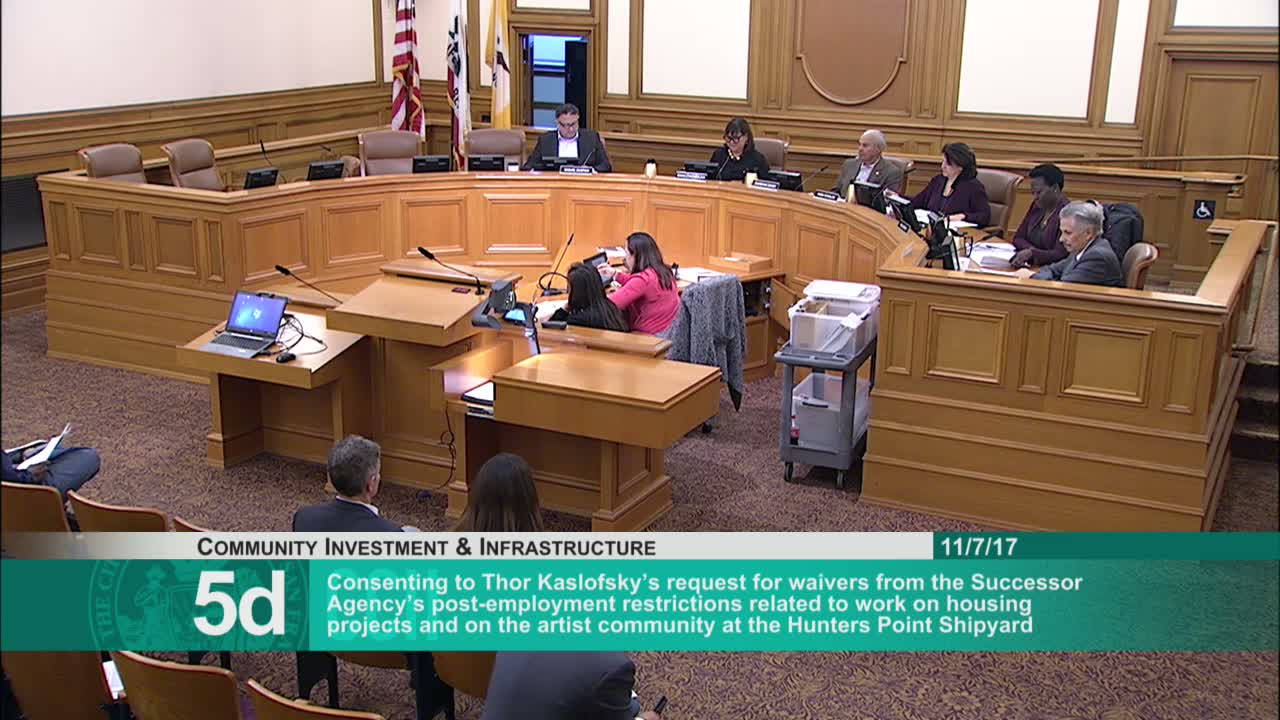
On Nov. 7, 2017 the Commission on Community Investment and Infrastructure authorized a ground lease and an amended and restated loan agreement to advance construction of a 119‑unit affordable rental project on Mission Bay South Block 3 East serving formerly homeless veterans and low‑income families.
The Commission on Community Investment and Infrastructure on Nov. 7 authorized the Director to enter into a 75‑year ground lease and an amended loan agreement to finance Block 3 East, a 119‑unit affordable rental development in Mission Bay South that will target formerly homeless veterans and low‑income families.
OCII staff said the project, led by Chinatown Community Development Center (CCDC) with Swords to Plowshares as partner, will include 62 units targeted for formerly homeless veterans (rented to households at roughly 30% of area median income) and 56 family units affordable at 60% AMI, plus one two‑bedroom manager’s unit. “The 3 East development will provide 119 units of affordable rental housing,” staff said during the presentation. Construction financing is expected to close and construction to begin in mid‑December, with occupancy targeted for fall 2019.
Financing presented to the Commission combined previously committed predevelopment funds and new construction support. Staff described an OCII loan for up to $20,593,000 (55‑year term, interest up to 3%), a $10,000,000 grant from the California Department of Housing and Community Development’s Veterans Housing and Homelessness Prevention Program, an award from the Federal Home Loan Bank’s Affordable Housing Program, and roughly $4.5 million in philanthropic donations that funded earlier predevelopment work. The ground lease includes base rent and a residual rent payable only if there is surplus cash flow, and restricts rents and incomes in perpetuity to conform to approved project documents.
Commissioners pressed staff on outreach and selection of residents. Staff said veterans’ units will be filled through coordinated referrals from the Department of Homelessness and Supportive Housing using that office’s coordinated entry system and working with the Mayor’s Office of Housing and Community Development to cross‑check certificate‑of‑preference (COP) holders. When asked whether staff could name a target count of COP holders for this site, staff said the list is a “moving target” and will be refined closer to lease‑up. Leon Winston of Swords to Plowshares told the Commission, “There are approximately 700 homeless vets on the by‑name list in San Francisco and of those about 100 are prioritized due to length of homelessness or vulnerability,” arguing for latitude to serve some veterans whose income or benefit structure may not perfectly match the unit income caps.
Contracting and small business participation were discussed. Staff reported roughly 48% participation to date for professional services and reiterated a 50% goal for construction‑phase inclusion; the general contractor and developer identified two to three joint venture opportunities they were exploring with San Francisco small business enterprises.
Commissioner Bustos moved authorization; Commissioner Singh seconded. The roll call vote was 4 ayes, motion carried. Approval permits the development team to close construction financing and begin the construction schedule presented to the Commission.
The approval record notes the project is within the scope of the Mission Bay Final Subsequent Environmental Impact Report (FSEIR) for purposes of the California Environmental Quality Act (CEQA). The development team will prepare an early outreach and lease‑up plan and work with service providers on supportive services for veterans.