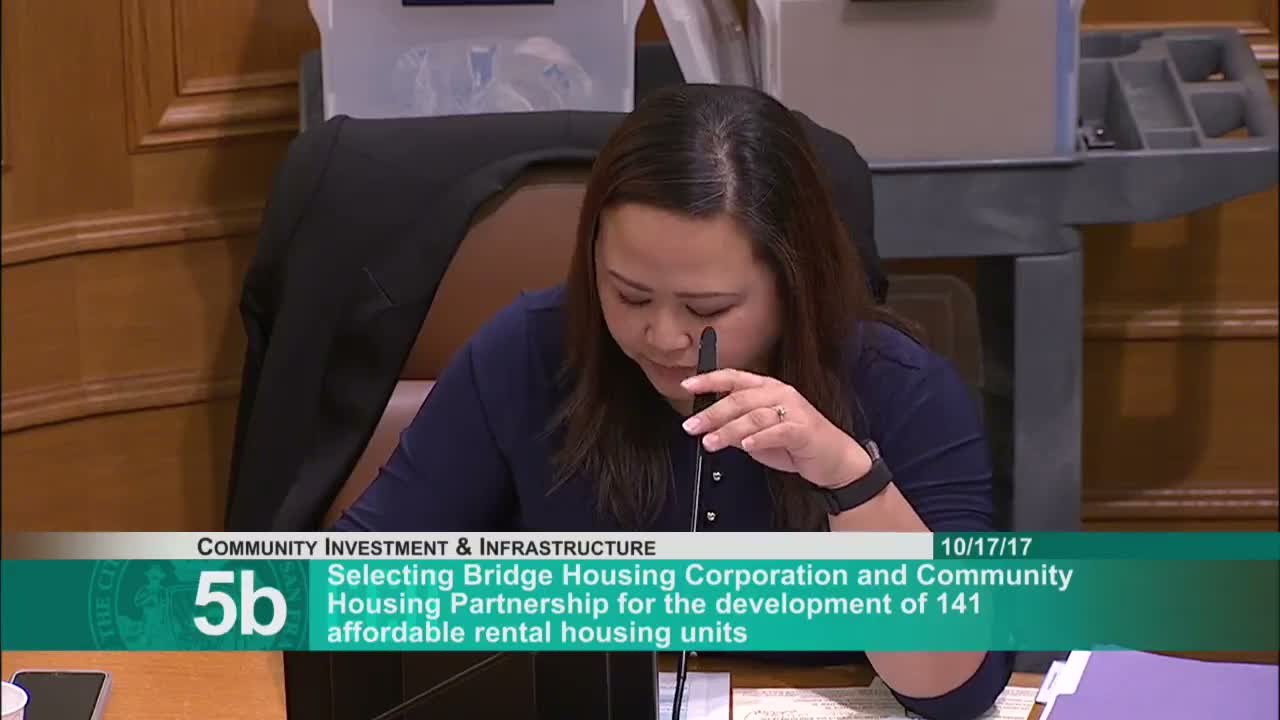
OCII selects Bridge Housing and Community Housing Partnership to develop 141 supportive housing units at Mission Bay Block 9
Loading...
Summary
The Commission approved OCII staff’s recommendation to select Bridge Housing and Community Housing Partnership (CHP) to develop about 141 affordable rental units with on‑site supportive services at Mission Bay South Block 9, after a lengthy public comment period that included calls for a strong good‑neighbor policy and clarity on tenant referral and construction timing.
The Commission on Community Investment and Infrastructure voted to approve OCII staff’s recommendation to select Bridge Housing and Community Housing Partnership (CHP) with LMS architects to develop approximately 141 affordable rental units, including one manager’s unit and on‑site supportive services, on Mission Bay South Block 9.
Kim Obstfeld, a development specialist with OCII’s housing team, told commissioners the RFP process produced two strong proposals and that the Bridge/CHP team received the highest total evaluation score. Obstfeld said the team proposed 141 units with a live‑in manager and seven‑day‑a‑week case management rather than weekday‑only coverage, and that the package includes community spaces, limited parking and bicycle amenities.
Corinne Woods, chair of the Mission Bay Citizens Advisory Committee, said the CAC had informational briefings and generally endorsed supportive housing while urging careful design and a robust good‑neighbor policy. “Concerns were raised about the quality of the design and how it would fit into Mission Bay, particularly if a modular building approach is used,” Woods said.
Community Housing Partnership CEO Gail Gilman described CHP’s record operating supportive housing and managing neighborhood relations: “Through our intensive service intervention, our residents reach a level of self‑sufficiency,” Gilman said, noting CHP’s portfolio of 17 properties in San Francisco. Supporters, including local advocacy organizations and residents, urged approval to address homelessness and create mixed‑income neighborhoods; nearby residents asked for better outreach and transparency about changes to the site’s intended use.
Commissioners pressed staff for operational details. Obstfeld and Margot Antonetti of the Department of Homelessness and Supportive Housing described tenant referral and screening: tenants for the initial lease‑up and ongoing vacancy fills will be referred through the city’s coordinated entry system and prioritized by need; Antonetti said the coordinated entry tool will prescreen applicants and then the development will perform usual lease applications.
On timing, staff said construction is anticipated to begin in 2019 with an estimated 12–18 months of construction depending on methods, and that OCII expects to return for predevelopment loan approval and an exclusive negotiation agreement next year. The team also described community outreach plans led by CHP’s James Tracy.
The motion to approve the Bridge/CHP team was moved by Commissioner Singh and seconded by Commissioner Pimentel. Roll call recorded yes votes from Commissioners Pimentel, Singh and Vice Chair Bustos; Commissioners Rosales and Chair Mondejar were absent. The motion carried (3 ayes, 2 absent).
The commission recorded that it will return to schematic design and community review later in the development process, when staff and the developer will present more detailed design, funding and construction timing information.