Get Full Government Meeting Transcripts, Videos, & Alerts Forever!
Get email alerts on the Ev Charging Ordinance topic
No spam. Unsubscribe anytime.
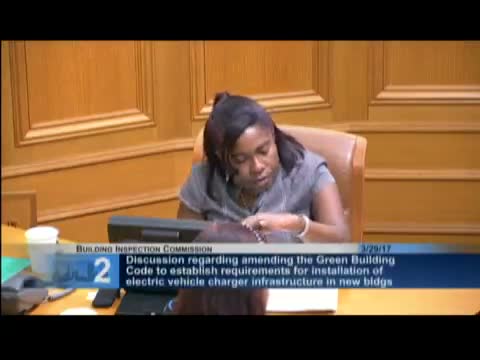
Building Inspection Commission backs ordinance requiring EV-ready infrastructure in new and altered buildings
Summary
The commission unanimously approved amendments to the green building code (Board of Supervisors file 170,202) requiring electrical capacity for EV charging in new construction and major alterations, advancing the measure to the Board of Supervisors after technical edits and calls for interagency coordination.
The San Francisco Building Inspection Commission on Wednesday voted unanimously to forward a proposed ordinance (Board of Supervisors file 170,202) that would amend the city’s green building code to require electric vehicle (EV) charging infrastructure in new buildings and in buildings undergoing major alterations.
The commission approved technical edits that keep a required electrical-system capacity equal to 20% of parking spaces and require 10% of spaces to be ‘‘turnkey’’ EV charging spaces — meaning a full circuit to the parking space terminating in a suitable receptacle — while removing a previously proposed second 10% requirement for empty conduits. A commission motion to approve the ordinance passed on a roll-call vote with five yes votes and no dissent; the item will go next to the Board of Supervisors.
Supporters, including a supervisor who opened the meeting and staff from the mayor’s office and SF Environment, framed the ordinance as part of the city’s broader climate strategy and as a way to expand access to EVs for residents who live in multiunit buildings. “I don’t have charging infrastructure in my building, and I would love to drive an electric vehicle,” the supervisor said, arguing the requirement would help residents consider cleaner choices when buying vehicles.
Tyron Zhu, senior advisor on environment for Mayor Ed Lee, urged the commission to act in the face of federal rollbacks of emissions initiatives and said urban centers account for a large share of emissions: “When we look at emissions data, 70% of our emissions are from our major urban cities,” he said, adding the ordinance aligns with regional utility plans to expand EV infrastructure.
Department of Building Inspection staff summarized the ordinance’s key elements and rationale. The staff presentation described the prior proposal’s structure and explained the recommended revisions: maintain a 20% electrical capacity requirement, require 10% of spaces to be turnkey EV-ready, provide room for future electrical panels and distribution infrastructure, and add post-occupancy tenant notification and an online list of covered buildings to encourage use of installed capacity. “The prior proposal … was a requirement for new buildings and certain major alterations to have sufficient electrical system capacity to simultaneously charge electric vehicles at … 20% parking spaces,” a DBI presenter said.
Commissioners pressed staff on the ordinance’s effect on affordable housing. Commissioner Gail Gilman asked whether 100% affordable projects would have an exemption given the layered costs of affordable development; DBI staff said affordable housing developers were consulted and that, where parking counts are low, incremental costs are modest. “If you have a very small number of parking spaces, the incremental cost is actually quite low,” DBI staff said, while noting appeals and hardship exceptions are available in the code for certain major alterations.
The Department of Public Works flagged implementation constraints related to transformer siting and the feasibility of locating required electrical equipment inside smaller infill buildings. Edgar Lopez of Public Works said the department supports the ordinance’s goals and offered to work with other agencies and utilities to streamline approval processes and consider sidewalk vaults where rooftop or in-building transformer siting is infeasible. “We would be happy to be a participant and … provide leadership and getting with the other agencies to figure out how we can be more supportive and streamline the process for these approvals,” Lopez said.
Tyron Zhu recommended bringing PG&E into conversations about transformer sizing and sidewalk vaults; he said the utility is expanding EV infrastructure but had not yet engaged on transformer-size and vault discussions tied to this ordinance.
Industry voices supported the direction of the ordinance in public comment. Joel Coppell, director of sustainable energy solutions for the San Francisco Electrical Construction Industry, urged the city to require installation of conduits and raceways during construction because EV-ready stations are selling out and retrofits are more costly. “If I’m on a job site, I’m always running all the lighting and power and whatever I can in the slab,” he said.
The commission recorded a roll-call vote after a motion to approve the item; President McCarthy, Vice President Walker, Commissioner Gilman, Commissioner Lee and Commissioner Warshall each voted yes. The commission’s action forwards the item to the Board of Supervisors, which the presenter said was expected to be reviewed by the Land Use Committee on April 10 and could move through the legislative process over the summer.
The commission did not adopt additional exemptions beyond the hardship and appeal pathways already in the proposed code language; staff said formal appeal pathways and director discretion would be available in narrow circumstances. The commission also asked staff to coordinate with Public Works, utilities and other stakeholders on implementation details and to clarify code language where needed.
The commission adjourned at about 10:40 a.m. The Board of Supervisors will receive the forwarded ordinance for further hearings and possible adoption.