Get Full Government Meeting Transcripts, Videos, & Alerts Forever!
Get email alerts on the Ev Infrastructure topic
No spam. Unsubscribe anytime.
City staff propose EV‑ready infrastructure for new construction; commission continues item to April
Summary
Department of Environment presented a proposed ordinance requiring new or major‑alteration buildings to be electrical‑service ready for Level‑2 charging (20% simultaneous Level‑2 capacity; 10% turnkey wired; additional 10% conduit or wired), citing cost savings of installing infrastructure at construction; commissioners voted unanimously to continue the item to April 19.
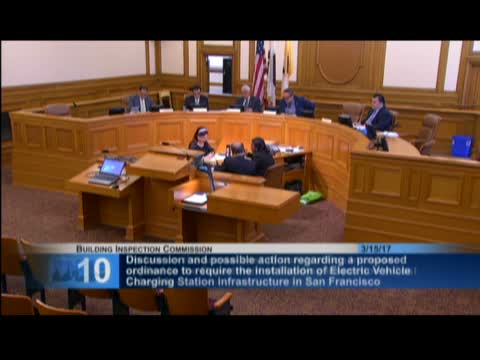
The Department of Environment presented a draft ordinance to the Building Inspection Commission on March 15 that would require new buildings and major alterations to include electrical infrastructure to support electric‑vehicle charging. Barry Hooper summarized the interagency work and code‑committee review that led to the draft and framed the proposal as part of San Francisco’s greenhouse‑gas reduction strategy.
The proposal would require building electrical service sized to support simultaneous Level‑2 charging for 20% of parking spaces. Additionally, 10% of parking spaces would be fully wired (turnkey) so a charger can be installed with minimal additional work; an additional 10% of spaces would be either fully wired or provided with an empty conduit and pull string sized to accommodate a 40‑amp circuit. For the remaining spaces the ordinance would require design documents and sleeves/conduits in accessible locations to allow future expansion of charging infrastructure. The measure targets new construction and major alterations (projects meeting an established high bar for scope), not ordinary minor renovations.
Hooper cited a cost analysis showing it is substantially cheaper to install EV infrastructure at construction than to retrofit later; the study used both state cost models and local calibration and found more than 65% savings in some scenarios. The ordinance would preserve flexibility: building owners could elect different charger types and determine pricing and access arrangements; the ordinance would not regulate who pays for charging or subscription models.
Public comment was strongly supportive of upfront readiness. Electrician and consultant Joel Koppel said EV‑ready spaces at a recently completed building sold out quickly: "We have our electric vehicle spaces over here that have been sold out since day 1," he said. Developers and homeowners said upfront conduit and wiring can be far cheaper to install during construction than after slabs and finishes are complete. Developers asked staff to consider how electrical‑service upgrades and PG&E costs would affect small builders and affordable housing projects; DBI and Department of Environment staff said they will continue stakeholder meetings and refine cost calibrations for large projects.
After public comment and discussion, Commissioner Lee moved to continue the item to the commission’s April 19 meeting to allow additional stakeholder outreach and language adjustments; the motion carried unanimously by roll call (President McCarthy: yes; Commissioner Constance: yes; Commissioner Lee: yes; Commissioner Warshall: yes).