Get Full Government Meeting Transcripts, Videos, & Alerts Forever!
Get email alerts on the Workplace Lactation topic
No spam. Unsubscribe anytime.
Building Inspection Commission backs Supervisor Tang—s workplace lactation ordinance and urges implementation guidance
Summary
The Building Inspection Commission unanimously recommended Supervisor Katie Tang—s ordinance requiring workplace lactation policies and minimum building standards for lactation rooms advance to the Board, while asking DBI to provide administrative bulletins clarifying thresholds and permit procedures.
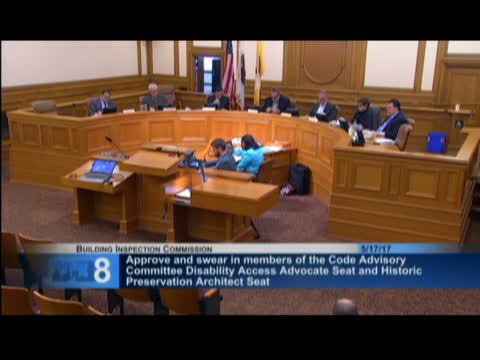
The San Francisco Building Inspection Commission voted unanimously May 17 to recommend a package of ordinances from Supervisor Katie Tang that would require employers to adopt lactation-accommodation policies and require technical standards for lactation rooms in certain new or remodeled employee spaces. Ashley Summers, legislative aide to Supervisor Tang, presented the proposal and the amendments before the commission.
Summers said the ordinance builds on state and federal rules by adding minimum standards for lactation spaces and an administrative process for requests. "Employers are already required to give these to their employees," she said, noting the local law would add safety and functionality standards: a surface for a pump and personal items, seating, access to electricity, and a 50-square-foot minimum per lactation station. She added employers must respond to a lactation request within five days and retain records of the request for three years.
The building-code portion would be triggered for tenant-improvement projects that meet a square-footage threshold (the draft before the commission used a 10,000-to-15,000 sq. ft. threshold in discussion) and for projects costing more than $500,000. Summers said staff will refine language so responsibility for installing required rooms falls to the entity that will occupy and pull permits for the space (for instance, a tenant improving leased floors).
Commissioners pressed staff on implementation details that would affect plan review and the counter process: how to determine whether required employee-designated area exceeds the 50-employee trigger; how planners and plan checkers will document an employer—s representation of employee count; and how the rule applies where a building owner shells a building before tenants occupy. DBI technical staff suggested the department could use occupant-load calculations, similar to how it currently assesses plumbing and exiting needs, and Summers offered to work with DBI on clearer language in an administrative bulletin.
Deputy City Attorney Rob Capla advised that the commission must act on the language before it as presented; Summers and commissioners agreed DBI should prepare an administrative bulletin or information sheet to address the implementation questions raised by staff and commissioners before the ordinance reaches the board. Commissioner Walker urged quick production of guidance to avoid permitting confusion.
The commission then moved, with a stated caveat that DBI develop administrative guidance to address the implementation issues raised at the hearing, and approved the recommendation on a unanimous roll-call vote. Summers said the ordinance was scheduled for hearings with the Land Use Committee and the full Board of Supervisors in the coming days.
Next steps: DBI and the supervisor—s office will work to finalize implementation language and an administrative bulletin for plan-check and permit-counter staff; the ordinance will proceed to the Land Use Committee and Board of Supervisors.