Get Full Government Meeting Transcripts, Videos, & Alerts Forever!
Get email alerts on the Community Health Housing topic
No spam. Unsubscribe anytime.
Residents urge OCII to weigh in on Candlestick Point garage and supportive housing; developers say changes made
Summary
At public comment, residents and neighborhood groups urged the commission to press the Candlestick Point developer to relocate or mitigate a large underground parking garage over health concerns; other speakers supported supportive housing at Block 9 and urged local hiring and park-naming opportunities.
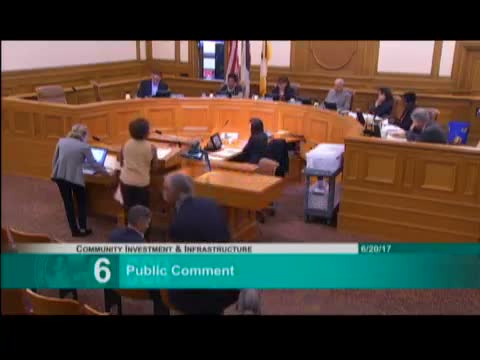
Dozens of residents, neighborhood leaders and advocacy groups used the commission's public-comment period to press officials about the Candlestick Point (Shipyard) development and upcoming affordable/supportive housing sites.
Shirley Moore, vice president of the Bayview Hill Neighborhood Association, said residents "oppose the garage" planned within the residential community, arguing vehicle queuing and exhaust could harm families and children who live within 100–300 feet of the site and play at Gilman Playground. "This proposed garage ... will be the largest garage in the city," Moore said, and she urged the commission to ask the developer to move the garage toward the water where exhaust could disperse.
Dr. Raymond Tompkins presented neighborhood air-monitoring and wind-microclimate data gathered under a grant, and said concentrations of particulates measured at the worksite were substantially higher than where residents live. He also cited local public-health data, saying asthma rates at a nearby elementary school were higher than the state average. "It is...they have legitimate concerns," Tompkins said, and he provided his data to the Air District for follow-up.
Several speakers, including members of housing and pro-housing organizations, urged the commission to move forward with supportive housing at Block 9 and to consider housing at Block 12W despite neighborhood opposition. Sonia Traus said a recent poll by her group found "75% of San Franciscans" support building affordable housing even when immediate neighbors object. Corey Smith of the San Francisco Housing Action Coalition and Peter Cohen of the Council of Community Housing Organizations said outreach and tours can reduce opposition by showing how supportive housing operates in other neighborhoods.
Dr. Veronica Honeycutt, chair of the Shipyard Community Advisory Committee, told commissioners the developer Lennar Urban made substantial changes following community meetings: elimination of a hillside garage, relocation of surface spaces into an adjacent garage, pushing taller buildings farther from Bayview Hill, shifting the residential tower and hotel, and placing parking underground. "The changes that have been made are substantial," Honeycutt said, and asked commissioners to tour the site to assess the entrance and potential impacts.
Speakers on both sides asked the commission to use its oversight powers to ensure the project's transportation demand management and mitigation measures are adequate for local health and safety. Commissioners closed public comment without taking immediate action on the garage location; several commissioners said they supported staff—ngagement with stakeholders and invited further documentation and study.
The commission did not vote on the garage location during this meeting; the public comment record and requests for a formal hearing or follow-up were left for staff and future agendas.