Get Full Government Meeting Transcripts, Videos, & Alerts Forever!
Get email alerts on the Budget Operations Debt topic
No spam. Unsubscribe anytime.
OCII budget workshop: administrative cap, retiree funding and DOF disallowance shape FY2017–18 operations plan
Summary
At an April 18 workshop the San Francisco Commission on Community Investment and Infrastructure heard staff outline FY2017–18 operations and debt-service proposals, including an ACA cap of about $3.6 million, $15.2 million in operating costs, a $113 million debt-service budget and a Department of Finance disallowance of roughly $600,000 for property-management work.
The Commission on Community Investment and Infrastructure on April 18 reviewed the agency’s FY2017–18 operations and debt-service budgets and heard staff describe limits on how much property tax increment the agency can use for administration and operations.
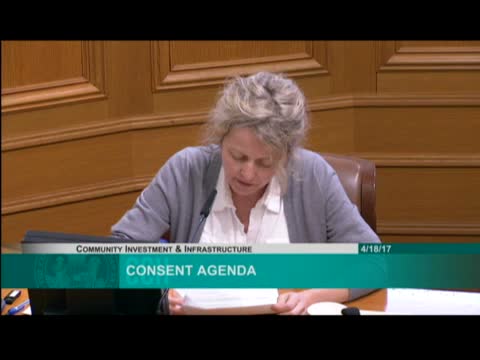
Deputy Director of Finance and Administration Bree Mahorter told commissioners the workshop focused on operations and debt service and builds on project-area budget discussions held April 4. She said the agency must present a five‑year property‑tax draw to the mayor’s budget office and controller so the city can integrate OCII figures into the city’s five‑year financial plan.
Mahorter summarized the agency’s constrained budget picture: retirement benefits, existing debt‑service obligations and project pledges (including Mission Bay and Transbay/TJPA pledges) are effectively fixed and not available for reallocation. “The only things that I can change are administration, direct project cost, and estimated debt service,” she said.
She explained two distinct property‑tax categories: RPTTF (redevelopment trust fund) for enforceable obligations and the administrative cost allowance (ACA). Citing recent law changes she said ACA is defined by a statutory formula and that this year OCII’s ACA cap is about $3.6 million. “That means that we, by law, may only spend $3,600,000 on our administration,” Mahorter said.
Mahorter presented the agency’s operating cost totals: roughly $8.4 million in existing salaries and benefits (47 full‑time equivalents), $4.0 million in non‑labor costs and $3.2 million in retiree pension and health obligations — about $15.2 million in total operating costs, well above the ACA cap. To manage that gap, staff allocate each position and non‑labor cost across project areas so as much as possible is charged to enforceable obligations or other revenue sources.
She also said OCII’s debt‑service budget is about $113 million, the majority of which covers tax allocation bonds issued against future property tax increment to pay for affordable housing and infrastructure built by development partners. Other obligations cited included hotel‑tax‑backed bonds, a Cal Boating loan tied to South Beach Harbor and a loan repaid to the low‑ and moderate‑income housing fund.
Mahorter also reported the Department of Finance reviewed OCII’s request to fund property management plan implementation and “disallowed about $600,000 of our $1,100,000 request,” mostly professional services for title, escrow, appraisals and related work. Staff said they will identify alternative approaches and return to the Commission in May with options.
Commissioners pressed staff in detailed questions about retiree‑liability calculations tied to hiring, the role and duration of limited‑term assignments, how several vacant positions had been reclassified in the current budget, the size and use of MOUs with city departments, and the status of repayments tied to prior ERAF‑era loans (Mahorter said OCII has made about $2 million per year payments and that approximately $16 million remains). Staff committed to follow up where more precise figures were requested.
The Commission will receive the full combined budget narrative and take action at its May 2 meeting before the mayor’s office review and submission to the Board of Supervisors.