
City officials report recent EOC activations, APEC lessons and rising regional threats including fentanyl and election risks
Get AI-powered insights, summaries, and transcripts
Subscribe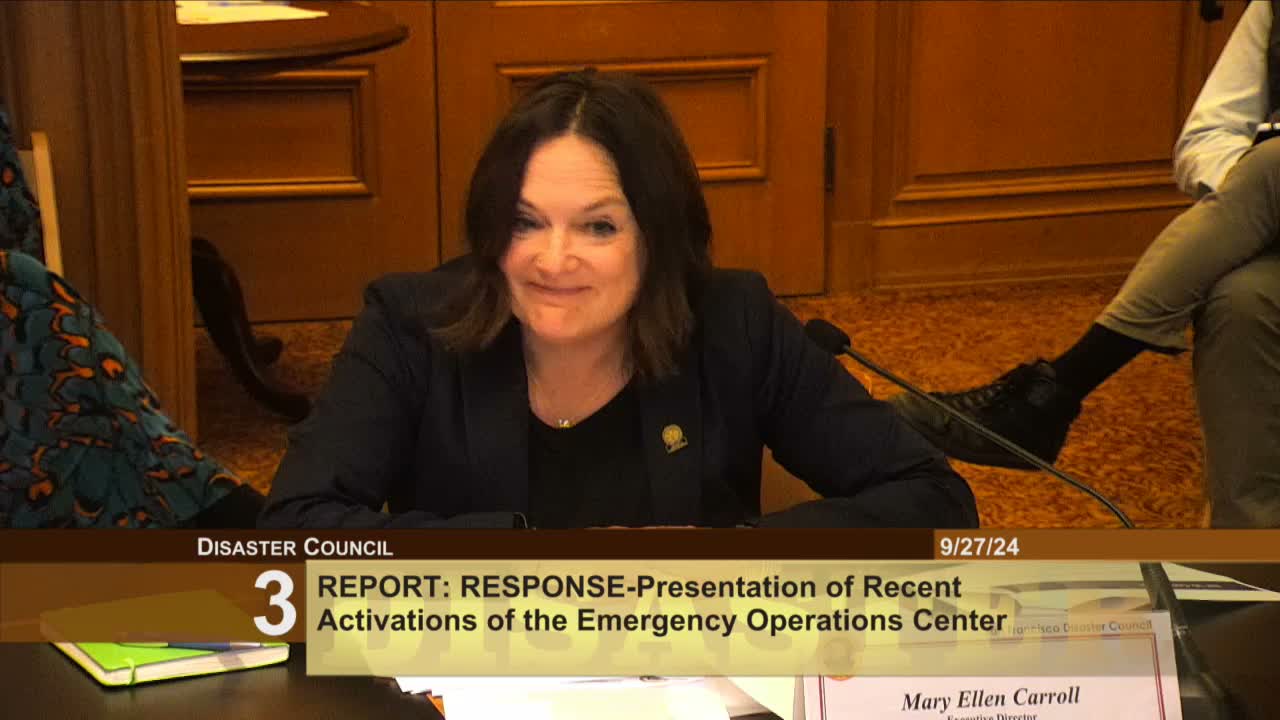
Summary
Deputy Director Adrienne Bekele said San Francisco activated the Emergency Operations Center 14 times since last August, including a 10‑day activation for APEC; regional intelligence and public‑safety leaders warned of rising foreign‑influence, cyber and fentanyl threats and outlined election‑security and phishing‑training steps.
Deputy Director Adrienne Bekele presented an overview of recent Emergency Operations Center (EOC) activations and operational lessons. “We've activated the EOC 14 times, since August of last year,” Bekele said, and described four activation levels that scale staffing and coordination. Bekele said APEC required the city’s most robust response: the EOC was activated for 10 consecutive days for APEC, including five days at the highest (level 1) activation, with 345 staff supporting operations during that period.
Bekele said the updated Emergency Operations Plan expands the concept of operations to include community lifelines, continuity-of-operations planning for departments, and a new community branch (ESF 16) to formalize two‑way communications with community partners and Board of Supervisors representatives.
Regional intelligence leaders briefed the council on threats. Mike Senna, who identified himself as executive director of the Northern California Regional Intelligence Center and the Northern California High Intensity Drug Trafficking Area, warned of active foreign‑aligned influence operations, cyber intrusions, and violent‑extremist risks. “We are at a point where our threats are extremely high right now. And our capabilities are low,” Senna said, adding that his office receives threat reports and routes relevant leads to local law enforcement and federal partners.
Senna highlighted a rising fentanyl distribution problem and provided seizure figures that show a steep multi‑year increase. He said seizures nationally and regionally have scaled from roughly half a ton at the program’s height to a recent annual figure he described as 14 tons (he noted seized quantities represent only a portion of the total supply). He also described a local count from the morning of the briefing: 987 law‑enforcement reports and 948 subjects linked to narcotics incidents; he said about 700 of those subjects were Honduran nationals.
Council members asked about election safety with 39 days until the contest; Senna and staff said election offices remain primarily local responsibilities on election day, federal agencies have limited on‑site roles, and the city is coordinating threat reporting and physical‑security planning with law‑enforcement and elections staff. The Department of Technology’s new executive director, Mike Nexmo, said the city runs an established phishing‑awareness and filtering program and is extending training to mobile/text channels while working directly with the elections department to protect sites and networks.
No formal votes were taken. City staff reported other operational updates — including an order of 12 programmed radios arriving next week — and announced upcoming volunteer NERRT drills and tabletop exercises to strengthen cross‑agency threat‑response and information‑sharing.