Get Full Government Meeting Transcripts, Videos, & Alerts Forever!
Get email alerts on the Vacant Building Enforcement topic
No spam. Unsubscribe anytime.
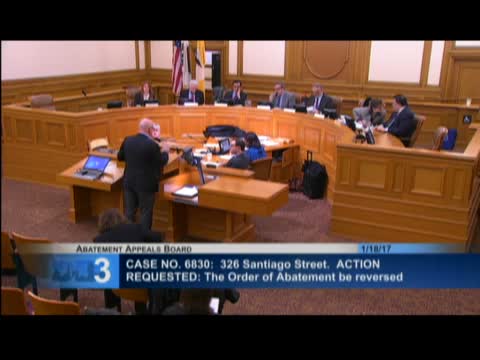
Board upholds abatement for 326 Santiago Street and enforces fees and penalties
Summary
The board upheld an order of abatement for 326 Santiago Street and voted 4–3 to impose the vacant-building registration fee, assessment costs and the 9x penalty multiplier after commissioners debated waiving the multiplier to aid the appellant's financing prospects.
The Abatement Appeals Board on Jan. 18, 2017, upheld an order of abatement for 326 Santiago Street and voted to enforce the vacant-building registration fee, assessment costs and the 9x penalty multiplier for unpaid registration.
Joseph Duffy, senior building inspector, told the board the building at 326 Santiago is a two-story, nonrated wood-frame single-family dwelling with outstanding life-safety hazards. He said a notice of violation was issued in March 2016 and that no subsequent building permit activity appears for that address. Staff recommended upholding the order (No. 108173A) and imposing assessments; Duffy described the annual registration fee as $711 and explained the ordinance penalty multiplies that fee by nine when unpaid, plus about $1,252.49 in code-enforcement assessment costs.
Appellant Ronald Daley, who identified himself as a partial owner, said the building has dry rot that makes it uninhabitable, that a hard-money lender is willing to fund repairs only if the city will subordinate its lien, and that the notice of abatement was recorded before the 30-day correction period expired. Daley said he secured the building and intends to renovate if financing can be obtained.
Commissioners debated two options: enforcing the full fee and penalty to uphold enforcement and neighborhood-protection objectives, or waiving the 9x multiplier in exchange for prompt payment of base fees and assessment costs to help the owner obtain financing. Vice President Walker and others favored negotiating payment terms to facilitate remediation, while Commissioner Warshall argued that the penalties exist to deter neglect.
The board voted first on a motion to uphold the order and impose the full assessment, including the 9x multiplier; the roll-call vote was 4 in favor and 3 opposed. The motion carried, upholding the abatement and directing assessment of costs and penalties as described.
The decision leaves an existing 2015 case and lien in place (staff said the 2015 case has been referred to the City Attorney) while resolving the 2016 appeal with assessments ordered.