Get Full Government Meeting Transcripts, Videos, & Alerts Forever!
Get email alerts on the Residential Hotel Conversion topic
No spam. Unsubscribe anytime.
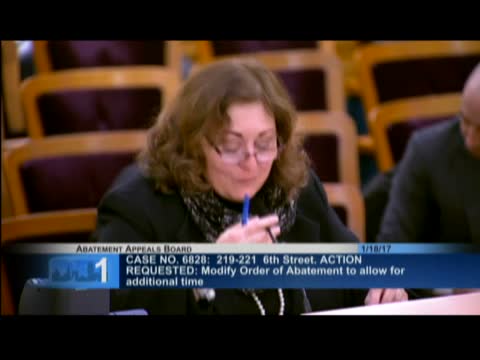
Abatement order for 221 Sixth Street upheld and held in abeyance for 12 months
Summary
The Abatement Appeals Board upheld an order related to an illegal conversion at 221 Sixth Street but held the order in abeyance for 12 months to allow the owner/applicant time to obtain planning approvals to legalize 30 guestrooms.
The Abatement Appeals Board on Jan. 18, 2017, upheld an order of abatement for 221 Sixth Street but held enforcement in abeyance for 12 months to allow the owner and applicant time to pursue planning and building permits.
Rosemarie Bosque, Chief Housing Inspector, told the board that inspections stemming from occupant complaints in 2014 found the building had been converted without permits from its last legal use of 19 residential guestrooms and two dwelling units to 30 guestrooms. Bosque said a Form 8 permit to legalize 30 guestrooms was filed on Dec. 23 (application no. 181223578) with a listed cost of $25,000, but that the case had been open for multiple years and staff recommended recording an order to compel compliance.
Appellant Henry Kornilowicz, appearing for the lessees, said the intent is to legalize the building as a 30-room single-room-occupancy (SRO) residential hotel and that the planning process — including conditional use and planning commission reviews — can take months. He asked the board for time to complete those steps.
Board members pressed staff and the applicant on technical issues including the distinction between dwelling units and residential guestrooms, minimum sleeping-room square footage and whether the residential-sprinkler ordinance would apply once the building exceeded 20 guestrooms. Bosque said those issues would also be reviewed by Planning and the Department of Building Inspection as part of the permit process.
Vice President Walker moved to uphold the order of abatement and hold it in abeyance for 12 months to allow time for the applicants to complete the permitting process; the motion was seconded and carried unanimously on a roll-call vote.
The board’s action preserves staff enforcement authority while giving the owner and applicant a defined period to pursue legalization through the city’s planning and permitting systems.