Get Full Government Meeting Transcripts, Videos, & Alerts Forever!
Get email alerts on the Redevelopment Prop O topic
No spam. Unsubscribe anytime.
Redevelopment commission approves plan amendments to implement Prop O for Hunters Point and Candlestick
Summary
The San Francisco Redevelopment Agency Commission voted 3–0 (two absent) to transmit narrowly tailored amendments to redevelopment plans that implement Proposition O--exempting specified portions of Hunters Point Shipyard and Candlestick Point from the city wide office cap set by Proposition M—and to adopt related CEQA findings for transmittal to the Board of Supervisors.
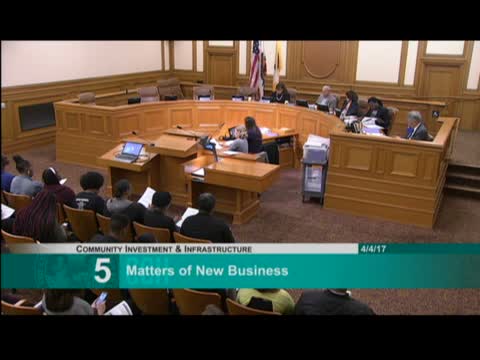
The San Francisco Redevelopment Agency Commission voted to transmit plan amendments to the Board of Supervisors to implement Proposition O and adopted related California Environmental Quality Act findings on April 4, 2017. The unanimous vote among present members — Commissioners Rosales and Singh and Chair Mondahar — followed a staff presentation and extensive public comment urging the Commission to move the project forward.
Tamsyn Drew, senior project manager for the Hunters Point Shipyard and Candlestick Point project, told the commission the amendments are administrative and "narrow," designed only to conform redevelopment plans to the voter-approved Proposition O by exempting Candlestick Point and phase 2 of Hunters Point Shipyard from the annual office-square-foot limitation established by Proposition M. She said the amendments do not change the total amount of development the redevelopment plans allow: "The redevelopment plan established a high-level threshold of up to about 5,000,000 square feet of research and development space," and the existing disposition-and-development agreement includes roughly 3,000,000 square feet of R&D, which remain unchanged.
The staff memo, presented as items 5B and 5C on the agenda, recommends transmittal of the amendments to the Board of Supervisors and adoption of environmental review findings under CEQA. Drew explained that local ballot initiatives cannot directly amend redevelopment plans, which is why the conforming amendments are before the Commission. If the Commission transmits the amendments today, staff said the Board of Supervisors would be asked to consider them at hearings anticipated in late May or June.
Public commenters — including longtime Hunters Point residents, community leaders and local contractors — overwhelmingly urged the Commission to transmit the amendments without delay. Rochelle Coleman, who identified herself as a San Francisco resident, said the exemption "will provide reasonable space for small and mid-sized businesses, which will translate to jobs for residents." Oscar James and others requested that community benefit dollars be prioritized for local businesses, youth training and housing for people returning from incarceration.
Commissioners asked staff whether the amendments would remove steps needed for developer approvals. Drew said the amendments would remove only the need to return to the Planning Commission for Prop M office-cap allocations in the exempted areas; schematic design reviews and disposition-and-development agreements would still come before OCII. Commissioners also pressed staff on workforce-development commitments. Drew cited the Bayview employment and contracting policy, which the presentation described as setting a 50% preference for jobs created by the project to be filled by Bayview Hunters Point residents as first priority, and cited existing partnerships with the city—s Office of Economic and Workforce Development and training academies.
The motions to transmit the plan amendments and to adopt CEQA findings were moved by Commissioner Singh and seconded by Commissioner Rosales. Roll calls recorded Rosales "yes," Singh "yes," and Chair Mondahar "yes;" Commissioners Pimentel and Vice Chair Bustos were recorded absent. Staff said the next step is transmittal to the Board of Supervisors.
The Commission's action implements the legal effect of Proposition O (approved by city voters on Nov. 8, 2016) through a conventional redevelopment-plan amendment process. Staff and speakers emphasized the change is procedural: it aligns the plans— approval processes with the voters' directive while leaving substantive entitlement limits in place.
What happens next: staff transmitted the report and CEQA findings to the Board of Supervisors for consideration; the Board was expected to schedule a hearing in late May or June. The Commission said it will continue to monitor workforce compliance and community benefits as project approvals proceed.
Quotes in this article are from the Commission meeting record. Vote: items 5B and 5C approved by roll call, 3 ayes (Rosales, Singh, Mondahar), 2 absent (Pimentel, Bustos).