Get Full Government Meeting Transcripts, Videos, & Alerts Forever!
Get email alerts on the Housing Redevelopment topic
No spam. Unsubscribe anytime.
OCII approves gap loan and updated replacement plan for Alice Griffith Phase 4
Summary
The Commission on Community Investment and Infrastructure voted 4–0 (one absent) to authorize a construction gap loan commitment for Alice Griffith Phase 4 and adopt an updated replacement housing plan, after staff outlined unit mix changes, financing needs and relocation protections and residents urged stronger community benefits and local hiring.
The Commission on Community Investment and Infrastructure voted to authorize a permanent gap loan commitment to support Phase 4 of the Alice Griffith public housing redevelopment and adopted an updated replacement housing plan, the agency said at its March 7 meeting.
Jeff White, housing program manager, told commissioners the Alice Griffith redevelopment — part of the city’s HOPE SF initiative — will replace 256 public housing units one-for-one and add approximately 248 tax-credit affordable units across six phases on seven blocks. White said the developer is requesting a gap funding commitment to apply for tax-exempt bond financing and low-income housing tax credits; the agenda materials list a maximum OCII loan amount as $12,986,033 while the presentation later referenced $12,986,000. The proposed loan term is 55 years at a 3 percent interest rate, with authority for the Executive Director of OCII and the MOHCD director to reduce the rate to as low as 0 percent if needed for tax-credit investor negotiations and IRS compliance.
White said prior work on phases one through three is under construction and that a $30.5 million Choice Neighborhoods Initiative implementation grant from the U.S. Department of Housing and Urban Development is supporting early phases, with $21.35 million earmarked for construction and the remainder for services and community improvements. He described a change to Block 5’s unit mix — shifting some larger four- and five-bedroom units to more smaller one- and two-bedroom units — citing current household composition at Alice Griffith and a desire to deliver some tax-credit units earlier.
The staff presentation addressed legal replacement obligations under the Community Redevelopment Law (CRL) as discussed in the materials, noting OCII must ultimately replace the original number and mix of larger units. White and staff explained that while current residents will be rehoused into appropriately sized replacement units, some CRL replacement units for four- and five-bedroom units may be provided elsewhere in OCII’s jurisdiction (for example, Candlestick parcels) if the immediate household need at Alice Griffith has shifted.
Elizabeth Chilton of the San Francisco Housing Authority described relocation supports for tenants: each resident may choose a federally defined ‘‘self-move’’ allowance (for example, the presentation listed about $1,165 for a one‑bedroom, $1,375 for a two‑bedroom, $1,665 for a three‑bedroom, $1,925 for a four‑bedroom and $2,215 for a five‑bedroom) or an arranged commercial mover; Five Point will cover relocation costs and the Housing Authority will pay the mover directly where used.
Public comment before the vote included tenants and neighborhood advocates who generally supported the redevelopment but urged stronger community benefits. Terry Anders of the Anders and Anders Foundation asked that local community organizations working with formerly incarcerated residents be considered for community benefit funds and hiring opportunities. Oscar James, a long-time Bayview Hunters Point resident, and Al Norman, president of the Bayview Merchants Association, pressed for more local hiring, better oversight to ensure small contractors are paid, higher-quality construction materials and pathways to homeownership. Mindy Kenner of Anders and Anders urged funding for ‘‘barrier removal’’ — for example, tools and work clothes — to help formerly incarcerated residents obtain jobs.
Daniela Gravil of McCormick, Baron Salazar, the developer partner, said returning public housing residents would generally pay 30 percent of income up to prescribed rents and that tax-credit units for the general public would follow lottery processes; the presentation cited a four‑bedroom tax‑credit rent example of $1,454 at 50 percent of area median income. Commissioners confirmed construction is expected to begin in July with completion of the phase by October 2018 under the proposed schedule, and that the financing applications to TCAC and other agencies would proceed soon.
Commissioner Bustos moved approval of the staff recommendations, and Commissioner Pimentel seconded. The roll call vote was four ayes, one absent; the motion carried.
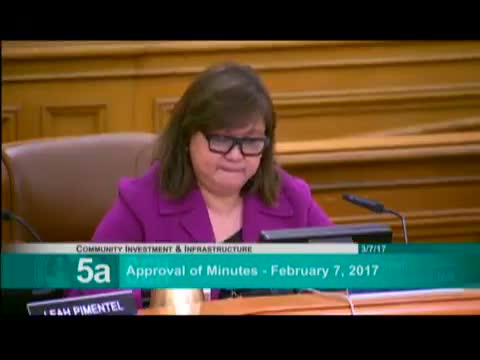
Votes at a glance - Approval of February 7, 2017 minutes: motion carried (mover: Commissioner Bustos; seconder: Commissioner Singh). Vote: 4 ayes, 1 absent. - Item 5B, Alice Griffith Phase 4 (gap loan authorization, updated replacement housing plan, CEQA findings): motion carried (mover: Commissioner Bustos; seconder: Commissioner Pimentel). Vote: 4 ayes, 1 absent.
What’s next Staff will finalize loan documents and proceed with applications for tax‑exempt bonds and low‑income housing tax credits. The Commission and staff said they will continue monitoring local hiring, small‑business participation and implementation of relocation and resident protections discussed at the meeting.