Get Full Government Meeting Transcripts, Videos, & Alerts Forever!
Get email alerts on the Certificate Of Preference topic
No spam. Unsubscribe anytime.
OCII extends Certificate of Preference program five years to 2021
Summary
The Office of Community Investment and Infrastructure approved a five-year extension of the Certificate of Preference (COP) program, citing outreach that located new holders and ongoing efforts to match displaced households to below‑market units. The action passed 3–0 with two commissioners absent.
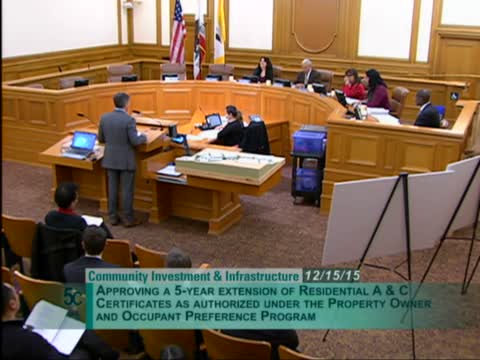
The Office of Community Investment and Infrastructure voted to extend the Certificate of Preference (COP) program for five years, moving the program’s new expiration date to 2021.
The commission’s staff and the Mayor’s Office of Housing and Community Development presented the extension at the Dec. 15 meeting and said the program, created under redevelopment law, gives priority in the leasing and sale of affordable housing to low‑ and moderate‑income households displaced by redevelopment project areas. Jeff White, OCII housing program manager, told commissioners the program “is set to expire 01/01/2016” and staff recommended a single five‑year extension so certificate holders continue to receive priority on eligible developments.
Maria Benjamin of the Mayor’s Office of Housing and Community Development described outreach and program metrics that helped shape the recommendation. Benjamin said staff identified 4,138 certificate records in their archives, that roughly 1,600 of those holders are deceased, and that recent outreach added about 125 new certificate holders after mailing roughly 1,100 letters. She noted that, as of Oct. 30, the office had issued 73 new certificates this year and that 95 COP holders had applied for housing in the last year, of whom 23 had been housed.
Public comment flagged concerns about implementation and representation. Ace Washington, who identified himself as a longtime community advocate, urged the agencies to create a monitor for the program and said the community needs greater oversight. “The trend is the black population is going down,” Washington said, arguing that outreach and community participation must improve.
Commissioners asked for detail on how lotteries are run and how holders are notified. Benjamin said COP holders are prioritized and processed ahead of general lotteries and described improvements to the city’s Dahlia listings system that staff expects to soft‑launch in January and to integrate with lotteries by April. She said the active outreach list is smaller than archival records — staff estimates roughly 800 actively contacted holders today — and that they are beginning to collect demographic and preference data for new and reissued certificates.
The commission approved the extension by roll call: Commissioner Mondejar, Commissioner Singh and Chair Rosales voted yes; two members were absent. Staff said the extension will allow the program to continue to notify holders of incoming opportunities and to operate the five lotteries scheduled for January.