Get Full Government Meeting Transcripts, Videos, & Alerts Forever!
Get email alerts on the Communications topic
No spam. Unsubscribe anytime.
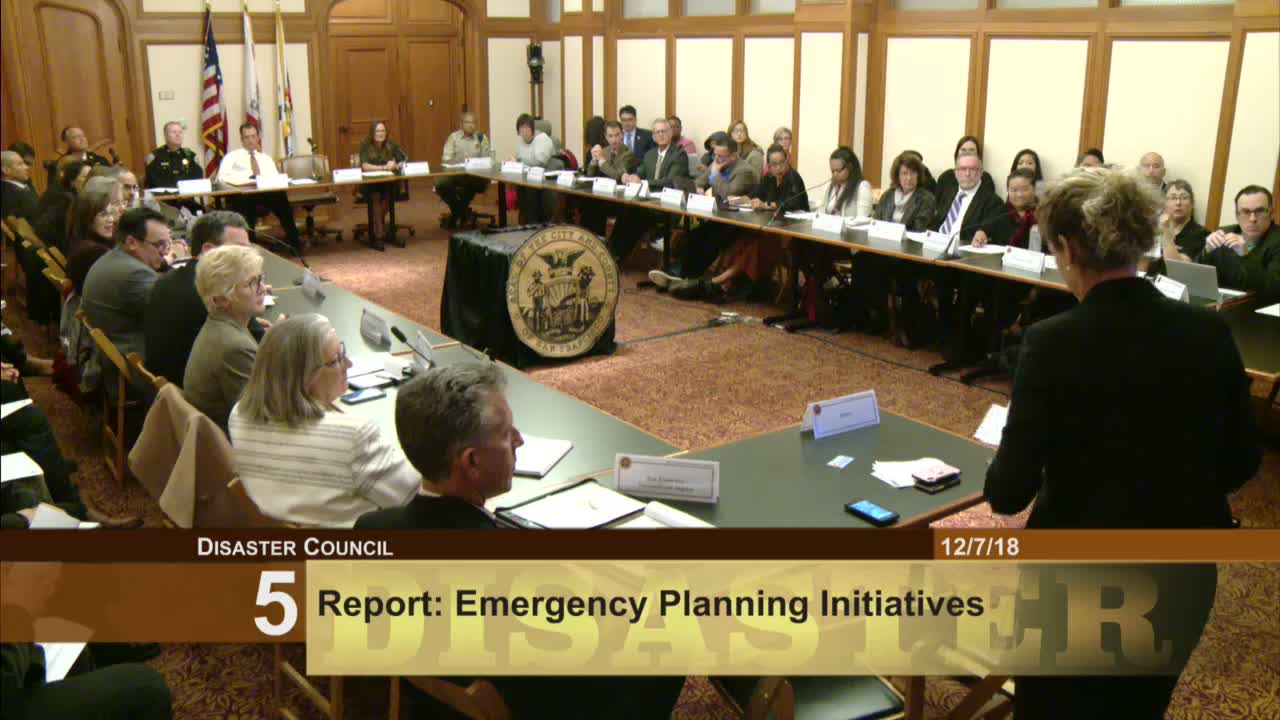
City reports mixed results in tests of FirstNet and carrier priority services; advises caution
Summary
San Francisco's Department of Technology and emergency management test results found variable performance for FirstNet and carrier priority services during dense events; staff described an $80 million radio upgrade under way and recommended a cautious, "slow the roll" approach to adopting priority broadband until coverage and Band 14 buildout improve.
Department of Technology staff told the Disaster Council that multi‑agency testing of commercial priority networks (AT&T FirstNet and Verizon's priority offering) produced inconsistent, highly variable results during large, dense events such as Fleet Week and the Pride parade.
Staff said the city is in the midst of an $80,000,000 radio‑system upgrade and that FirstNet and Verizon priority services provide preemption and priority for first responders. At the same time, testers showed gaps in user experience and geographic coverage — presenters noted overall green coverage figures above 98% on some maps but pointed to red gaps on commute corridors and in surrounding Bay Area areas where disasters could cross jurisdictional lines.
Presenters demonstrated InPerf and other apps used for speed and latency testing on consumer devices (iPhone and Samsung Galaxy S8) and cautioned that cell‑on‑wheels deployments for events can skew results. "We tested these networks in high dense, usage events," a presenter said, and concluded that "individual user experience is not where it needs to be with these networks."
Given those findings, staff recommended a careful rollout strategy: a "slow your roll" posture to avoid premature large investments in devices and services until Band 14 buildout and carrier coverage improve. They committed to re‑testing when additional infrastructure comes online.
Why it matters: Reliable communications are essential for incident response and coordination. City staff recommended balancing investments in commercial priority services with continued investment in the planned radio upgrade and contingency assets such as cell‑on‑wheels and satellite Wi‑Fi trailers.
Next steps: Staff will continue testing (including after Band 14 improvements), provide test results to department leaders, and refine procurement and device‑upgrade recommendations; they also said the city received a grant to acquire satellite Wi‑Fi trailers for multi‑county deployment.
Attribution: Technical findings and recommendations are drawn from presentations by Department of Technology staff and testing-team members.