Get Full Government Meeting Transcripts, Videos, & Alerts Forever!
Get email alerts on the Air Quality topic
No spam. Unsubscribe anytime.
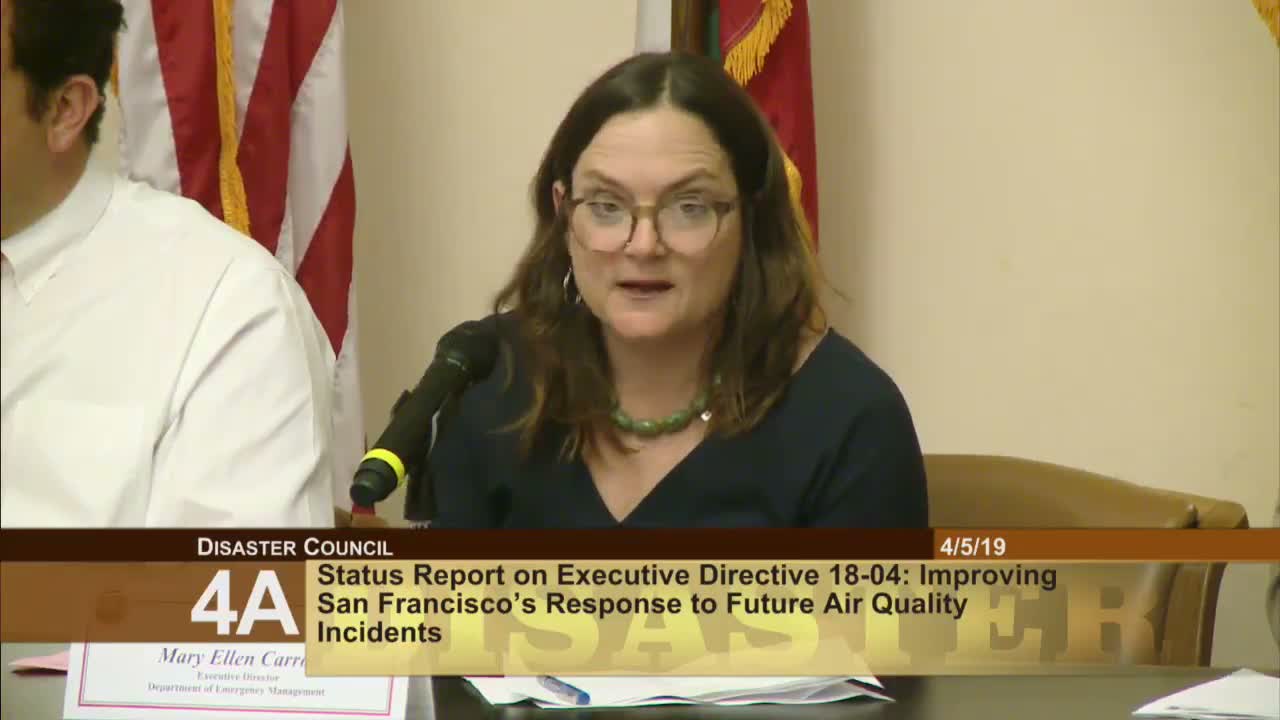
San Francisco disaster council weighs flexible air-quality rules, regional messaging and cleaner-air centers
Summary
Public-health and emergency officials updated the Disaster Council on an updated air-quality response plan stressing tradeoffs in protective guidance, a regional messaging toolkit, and a city facilities inventory to identify potential cooling/clean-air centers before the next smoke or heat events.
San Francisco officials on the Disaster Council outlined steps to sharpen the city’s response to future smoke and heat events, stressing that technical tradeoffs mean public guidance must be precise and regionally coordinated.
Dr. Thomas Aragon, presenting on Executive Directive 18-4, said the city treats air quality through three domains — the natural environment, the built environment and people — and emphasized that “there are really gap areas, and there’s some areas where there’s no right answer. There’s only tradeoffs.” He told the council that officials are revising the city’s AQI matrix to be more flexible and to allow more time for deliberation before ordering operational changes in a rapidly evolving incident.
Why it matters: Officials said smoke events interact with heat risk and building conditions. Aragon highlighted a practical dilemma: advising people to shelter indoors for smoke protection can harm people without air conditioning during high heat. He urged planning that accounts for those conflicting risks and for vulnerable groups including seniors, children, pregnant people and those with cardiopulmonary disease.
The Office of Resilience and Capital Planning is compiling an inventory of city facilities that could function as cleaner-air or cooling centers. Brian Strong said the office has been interviewing departments that manage facilities — Recreation and Park, libraries, Department of Public Health and the PUC — and plans a preliminary facilities list and a report to the council in the coming months.
At the regional level, Francis Zamora explained a Bay Area-wide public-information effort being developed by the Department of Emergency Management and Public Health with the Bay Area Air Quality Management District and the Association of Bay Area Health Officers. The project’s goals include a public-information toolkit for before/during/after events, translated materials for Bay Area threshold languages, a resource guide for hard-to-reach populations, and a digital repository so jurisdictions can reuse messages.
Zamora described survey work with community-based organizations and public information officers and said an initial toolkit and regional workshop are scheduled for late May to June, with continued refinement through September.
What’s next: Officials said the revised AQI grid, the facility inventory and the regional toolkit will return to the council for additional review. The council did not take formal action on these items at the meeting.