Get Full Government Meeting Transcripts, Videos, & Alerts Forever!
Get email alerts on the Public Safety topic
No spam. Unsubscribe anytime.
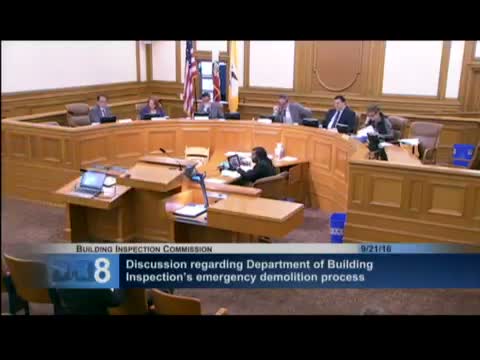
DBI outlines emergency demolition checklist proposal amid interagency delays
Summary
Deputy Director Dan Lowry described the emergency demolition process — engineer sign‑offs, asbestos/lead testing, contractor licensing and Bay Area Air Quality JN numbers — and commissioners asked for a pre‑issuance checklist and lead contacts to prevent demolition permits that cannot proceed because of other agencies' requirements.
Deputy Director Dan Lowry summarized DBI's emergency demolition process, listing the required steps used when a structure presents an imminent hazard: an engineer's finding, DBI engineer verification, director and deputy director sign‑offs, asbestos and lead hazard documentation, contractor licensing and registration, Bay Area Air Quality Management JN numbers, and Department of Environment debris receipts.
Lowry said the department has tightened documentation requirements to reduce risk: "We also like to show all licenses required to perform a demolition, including an inactive and valid California contractor state license, a new C22 asbestos abatement requirement..." He added that projects now require structural geotechnical oversight during demolition work.
Commissioners expressed frustration that emergency demolition permits sometimes stall because other agencies (PG&E, Muni, BAQMD) must complete steps such as meter removal, street closures or air‑quality JN numbers, creating public perception that DBI issued a permit but work did not occur. Director Tom Hui and DBI staff said contractors must be qualified and familiar with city processes; staff proposed a pre‑issuance checklist and identifying a lead contact at other agencies to expedite interagency steps.
A number of contractors and engineers in public comment urged codifying standards and creating a cross‑agency working group to develop checklists and post‑earthquake protocols. An engineer with demolition experience recommended separate procedures for ordinary blight versus post‑earthquake urgent demolitions and suggested an administrative bulletin or code amendment to capture the policy.
Next steps: DBI agreed to pursue outreach to partner agencies to identify lead contacts and to return with a proposed checklist or policy that would better document prerequisites before an emergency demolition permit is issued.