Get Full Government Meeting Transcripts, Videos, & Alerts Forever!
Get email alerts on the Air Quality topic
No spam. Unsubscribe anytime.
Mayor Breed directs overhaul of San Francisco's poor-air-quality response and orders task force
Summary
Mayor London Breed announced an executive directive ordering the Department of Public Health and Department of Emergency Management to revise the city's poor-air-quality plan, create a task force to identify public respite facilities and improve multilingual and disability-accessible communications; DPH urged public education on respirator use and fit testing.
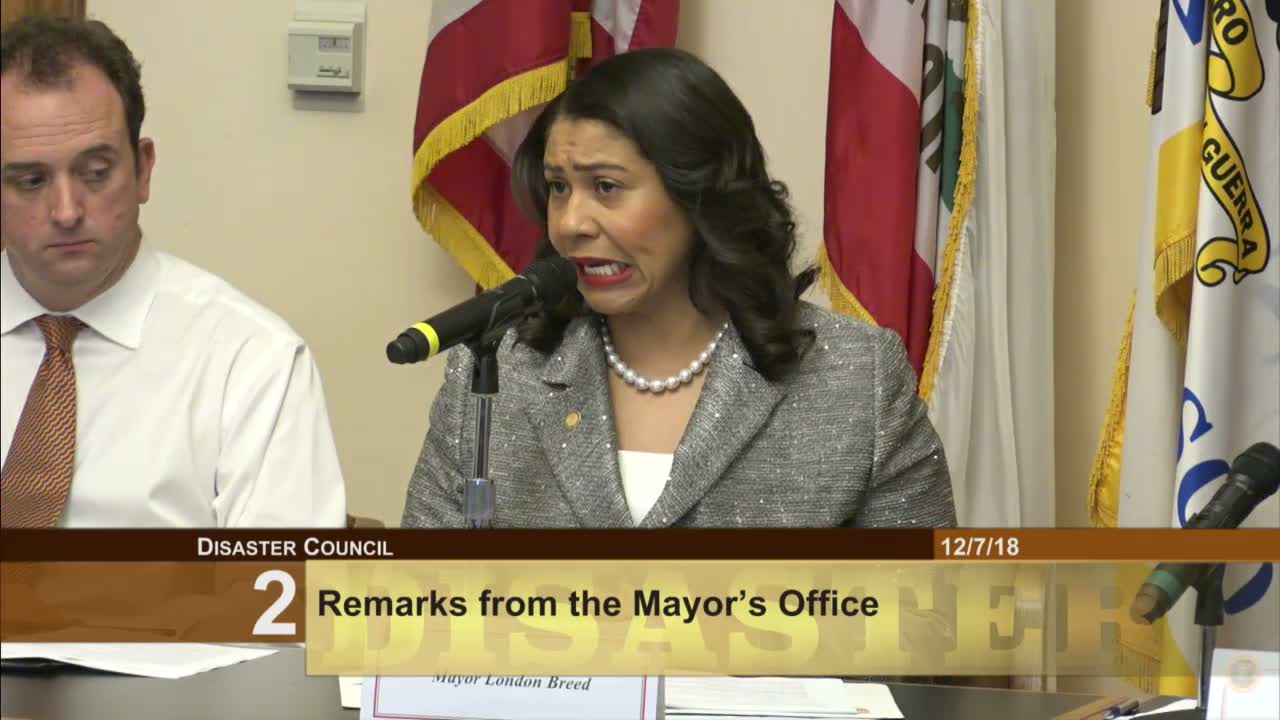
San Francisco Mayor London Breed announced an executive directive at the Disaster Council meeting instructing the Department of Public Health and the Department of Emergency Management to co-lead a revision of the city's plan for poor‑air‑quality incidents and to establish a task force to recommend locations and standards for public respite facilities.
The directive, Breed said, will "get to a better place in terms of being able to deal with any situation as it occurs," and directs DEM, led by Mary Ellen Carroll, to convene a multiagency task force including DPH, the Human Service Agency, the Department of Homelessness and Supportive Housing, Recreation and Park, and the San Francisco Public Library to develop guidance on facility effectiveness, benefits and locations.
The move follows prolonged wildfire smoke episodes that pushed local air quality index readings in many places well above typical levels, Breed said, and it includes a requirement that communication strategies be multilingual and accessible to people with disabilities. "The information will also be accessible to people with disabilities," she said, emphasizing outreach to seniors and vulnerable populations.
Dr. Thomas Aragon of the Department of Public Health told the council that particulate matter (PM2.5) is the primary health concern from wildfire smoke because these tiny particles can penetrate deep into the lungs. He summarized current public-health guidance and distributed a one-page handout from the California Department of Public Health that summarizes issues around N95 respirators.
On respirators, Aragon said the city should call these devices "respirators" rather than "masks," because they require a tight face fit to work. "They're called respirators because... you have to have a tight fit on your face," he said, adding that fit testing and medical clearance are standard in clinical settings and that respirators can impose a physiologic burden for people with underlying heart or lung disease. He urged public education on safe use and access while acknowledging that members of the public will use respirators regardless of official guidance.
Why it matters: The directive creates a clear line of responsibility for the city's air-quality response, names agencies to coordinate shelter and respite strategies during smoke events, and adds an explicit communications requirement aimed at reaching populations that may not access online alerts.
Next steps: DEM and DPH will co-lead revision of the poor-air-quality plan and establish the task force; city staff said they will return with more specific recommendations and outreach materials. The mayor said the directive material was distributed to attendees.
Attribution: Quotes and attributions are drawn from statements made at the Disaster Council meeting by Mayor London Breed and Dr. Thomas Aragon of the Department of Public Health.