Get Full Government Meeting Transcripts, Videos, & Alerts Forever!
Get email alerts on the Vaccine Equity topic
No spam. Unsubscribe anytime.
DAS report stresses vaccine equity for older adults and people with disabilities
Summary
San Francisco's Department of Disability and Aging Services told the commission Feb. 3 that limited vaccine supply and fragmented provider allocations have produced confusion and that the city is prioritizing equity with targeted sites and outreach to reach high-risk older adults and people with disabilities.
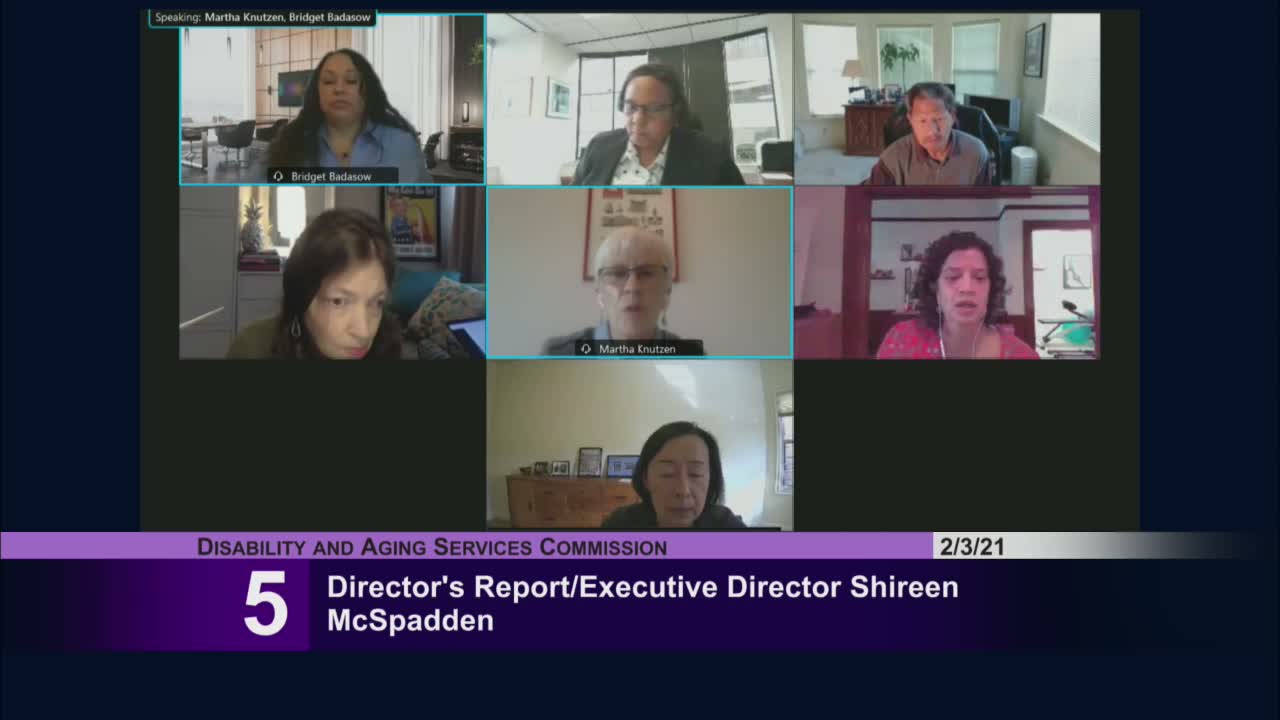
San Francisco Department of Disability and Aging Services Executive Director Shereen McSpadden told the commission on Feb. 3 that the department is working with the Department of Public Health, the Office of Emergency Management and community partners to prioritize vaccinations for older adults and people with disabilities amid limited supply.
McSpadden said the city has identified targeted distribution sites — including pop-up sites in the Mission and Bayview-Hunters Point, City College and Moscone Center — and is coordinating with health-care providers and CBOs to reach people who cannot easily travel to mass sites. "We're really thinking about equity, upfront," McSpadden said, describing efforts to conduct outreach in multiple languages and use trusted local messengers.
Commissioners pressed McSpadden on implementation details. Vice President Janet Spears asked when the department's community needs assessment will launch; McSpadden said the assessment project is starting now and staff expect preliminary results late spring or early summer and that it will inform future RFPs and contracting. Commissioner Nelson Lum asked about plans to reach frail, homebound older adults; McSpadden said the city is exploring transportation assistance and "roving teams" for congregate buildings while acknowledging in-home vaccination for isolated individuals remains logistically complex.
McSpadden also described DAS's effort to prioritize In-Home Supportive Services (IHSS) providers and recipients for vaccination, noting education sessions in multiple languages and partnerships with Homebridge and the public authority to facilitate access.
The report linked local efforts to federal and state developments: McSpadden highlighted a recent federal stimulus provision that included funding for elder-justice programs and said officials are monitoring the Biden administration's vaccine ramp-up but warned that meaningful volume increases may take months. The department reiterated that outreach, multilingual messaging and coordination with trusted community organizations are central to its approach as supply and eligibility rules evolve.
The commission's discussion closed with a commitment from staff to continue outreach coordination and to provide follow-up details on the needs assessment timeline and vaccine strategies at future meetings.