Get Full Government Meeting Transcripts, Videos, & Alerts Forever!
Get email alerts on the Regional Exercise topic
No spam. Unsubscribe anytime.
Regional "Yellow Command" exercise and SFO drills tested sheltering and unified command
Summary
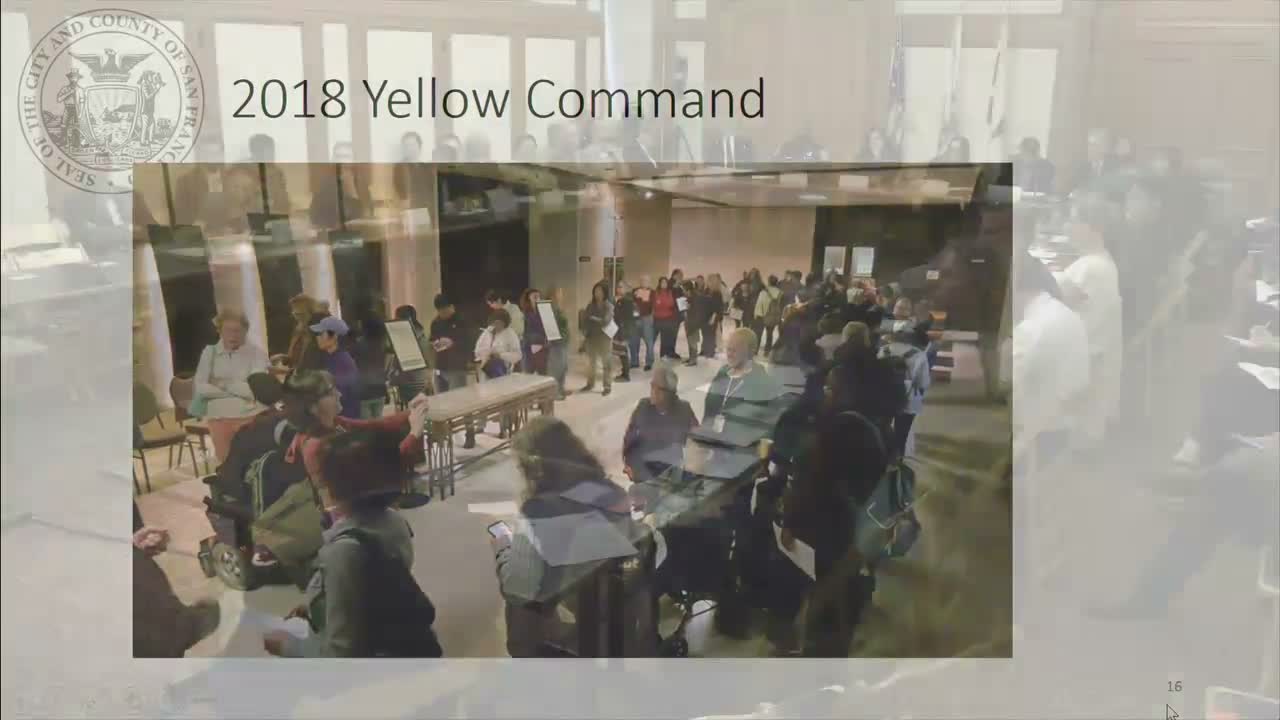
Officials said the Bay Area's Yellow Command exercise (Sept. 6 scenario) activated nearly 3,000 participants across 12 counties and tested mass-care and sheltering—including a San Francisco activation at St. Mary's Cathedral with an integrated medical treatment area.
Corinne Bachir, the exercise director for Yellow Command, told the council the Sept. 6 regional exercise used a 7.9 earthquake scenario to practice mass-care and shelter operations across the 12-county Bay Area. "Our intent was to build local government capabilities to provide mass care and shelter services for those 300,000 plus folks throughout the Bay Area region," Bachir said, describing 18 full-scale shelter operations, activation of nearly 55 local emergency operation centers and close to 3,000 participants.
Doris Barone described San Francisco's participation: St. Mary's Cathedral was selected as a vetted shelter site to test the city's ability to set up and manage a shelter and to integrate a medical treatment area led by the Department of Public Health. The city staffed the site with Human Services Agency personnel and DPH clinicians and used more than 80 community volunteers as survivor actors to train shelter staff in intake and on-site support.
Speakers said the exercise tested incident command, unified command transfer (including to Coast Guard where appropriate), triage and victim tracking systems developed after past incidents, and joint staffing plans with the Red Cross, Salvation Army and other partners. Officials highlighted that the first days after a catastrophic event will rely largely on city and regional mutual-aid partners, with external federal support coming later in the response.
The council said lessons from Yellow Command will inform next year's focus (transportation) and that local shelter and medical-in-shelter concepts proved useful to refine staffing and communications protocols.