Get Full Government Meeting Transcripts, Videos, & Alerts Forever!
Get email alerts on the Resilience Planning topic
No spam. Unsubscribe anytime.
City advances Resilient SF, Lifelines and Restoration Timelines to speed recovery
Summary
City resilience staff reported progress on the Resilient SF plan, the Lifelines Council's interdependency work and a Restoration Timelines Project to estimate how long utilities and services would take to recover after a major earthquake; officials encouraged participation in the Epicenter conference.
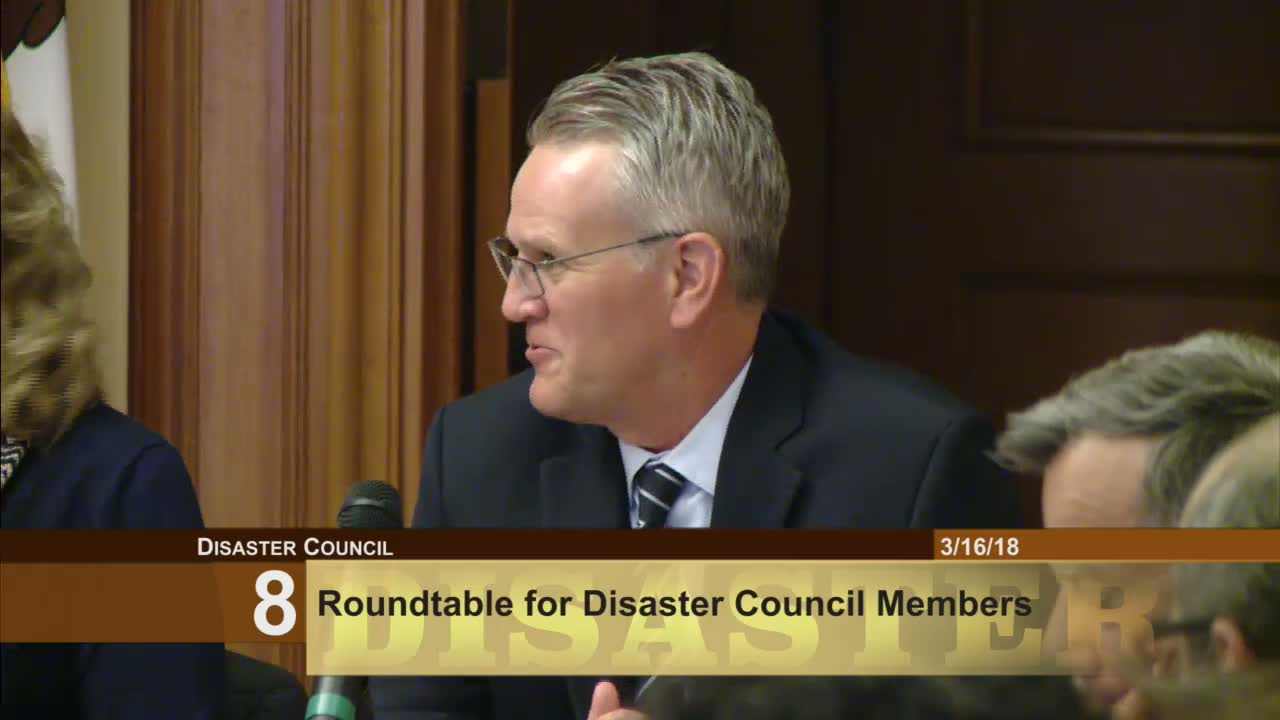
Brian Strong, the city's chief resilience officer, told the Disaster Council the city is advancing its Resilient SF plan ("Stronger Today, Stronger Tomorrow") and working with utilities, transportation providers and regional partners to develop a Restoration Timelines Project that models how long 14 lifelines (power, water, communications, transportation, etc.) will take to return after major earthquakes.
"We're looking at a 7.9 on the San Andreas and a 7 on the Hayward Fault," Strong said, explaining that the Restoration Timelines work will use national and international research to estimate recovery stages for utilities and other lifelines. The effort, he said, informed seismically focused exercises and the city's priorities for mitigation and retrofit.
Why it matters: Recovery planning pre-establishes processes and priorities so the city can coordinate rebuilding and funding quickly after a catastrophe. Strong warned that without an agreed recovery framework, third parties or outside actors might set priorities for the city during the recovery phase.
What happened: Strong reviewed the Lifelines Council (quarterly forum with PG&E, communications providers, transit agencies, Public Utilities Commission and other stakeholders) and said the restoration work included presentations from the California Energy Commission and port officials about regional performance after an event. He also described the city resilience index project (in partnership with Rockefeller Foundation and Arup) that will produce indicators to guide priorities.
Community engagement and pilot programs: Strong highlighted Neighbor Fest community events (32 events, ~3,000 attendees) as part of neighborhood capacity building; he invited Disaster Council members to participate in the Epicenter conference and in recovery-framework planning.
Next steps and deliverables: Officials said a draft disaster debris management plan will be submitted to FEMA in the coming months; the restoration timelines and resilience index projects expect results in 3—2 months; and the recovery framework is a priority to complete within the coming year.
The meeting produced no formal decisions; staff offered to follow up with interested departments and partners.