Get Full Government Meeting Transcripts, Videos, & Alerts Forever!
Get email alerts on the Hazards Climate Resilience topic
No spam. Unsubscribe anytime.
San Francisco plans combined hazards and climate resilience update to meet SB 379 requirements
Summary
City officials said they will submit a combined Hazards and Climate Resilience Plan to Cal OES in July 2019 that incorporates AB 379 (SB 379) requirements to include climate adaptation in the hazard mitigation and safety element updates; the plan will inform capital planning and five‑year priorities.
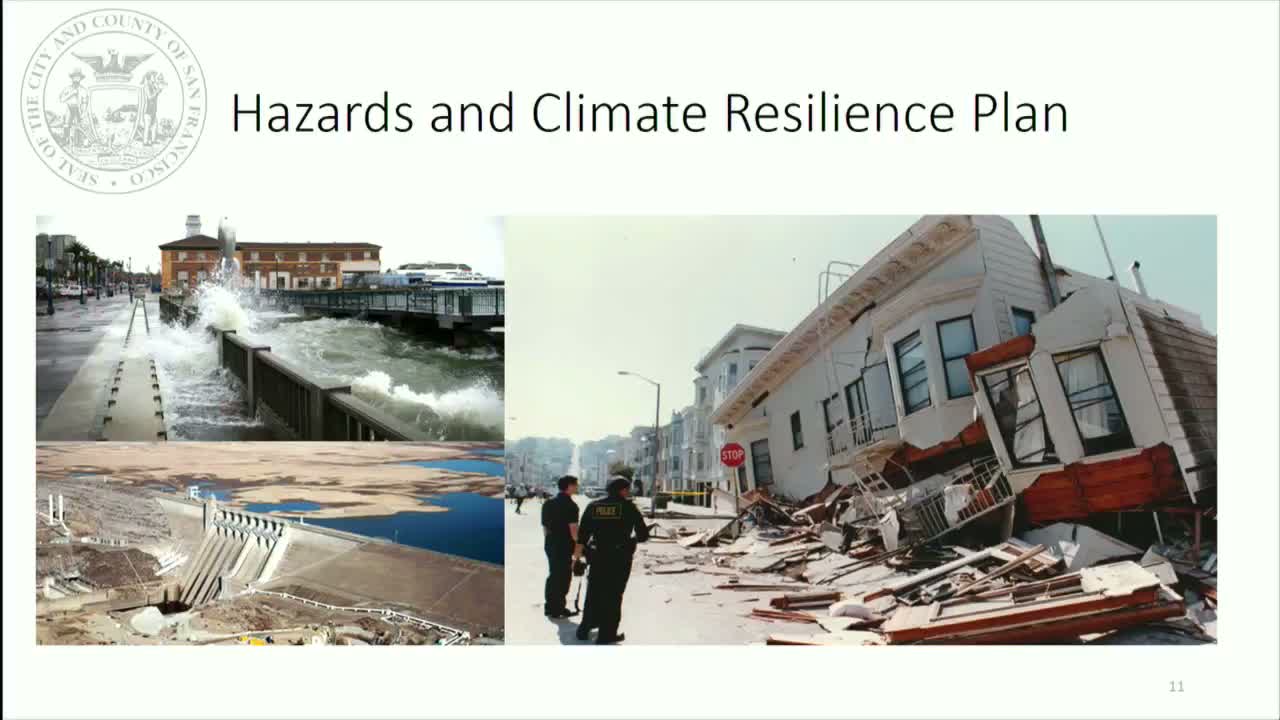
Melissa Higbee, principal resilience analyst, told the Disaster Council the city is producing a Hazards and Climate Resilience Plan that combines the five‑year hazard mitigation update with a climate adaptation effort to satisfy SB 379. "My name is Melissa Higbee. I'm a principal resilience analyst in the Office of Resilience and Capital Planning," she said, and outlined the plan's goals: assess how hazards are changing in frequency and severity due to climate change, develop longer‑term actions to reduce impacts and provide direction for capital planning and policy.
Melissa said the effort builds on the 2014 hazard mitigation plan and will align departmental hazard mitigation and climate adaptation work into a citywide framework. The plan will include a community engagement strategy to reach stakeholders and communities most affected by hazards and climate impacts and staff aim to submit the draft to Cal OES in July 2019.
Brian and others also described complementary initiatives: a Lifelines restoration performance project that has scheduled interviews with 14 lifeline providers including utilities and the PUC to clarify expected recovery timeframes, and updates to the city's 10‑year capital plan where over half the expenditures historically go to earthquake work.
Council members heard status updates on the soft‑story retrofit program: tier 3 (about 3,400 buildings) is at roughly 90.7% compliance (permits filed), private owners have invested about $158 million so far (averaging roughly $78,000 per building) and tier 4 (about 5,600 buildings) remains the most challenging with ~58% in compliance ahead of upcoming deadlines.
No formal actions were taken; staff said they will return with updates as the plan progresses and as Cal OES review proceeds.