Get Full Government Meeting Transcripts, Videos, & Alerts Forever!
Get email alerts on the Emergency Response topic
No spam. Unsubscribe anytime.
San Francisco responders outline mutual-aid challenges and lessons from North Bay fires
Summary
San Francisco officials and partners reported on deployments to the North Bay fires, citing more than 1,000 city personnel deployed, communications and radio interoperability failures, stretched staffing and a surge of volunteers that required rapid training and management.
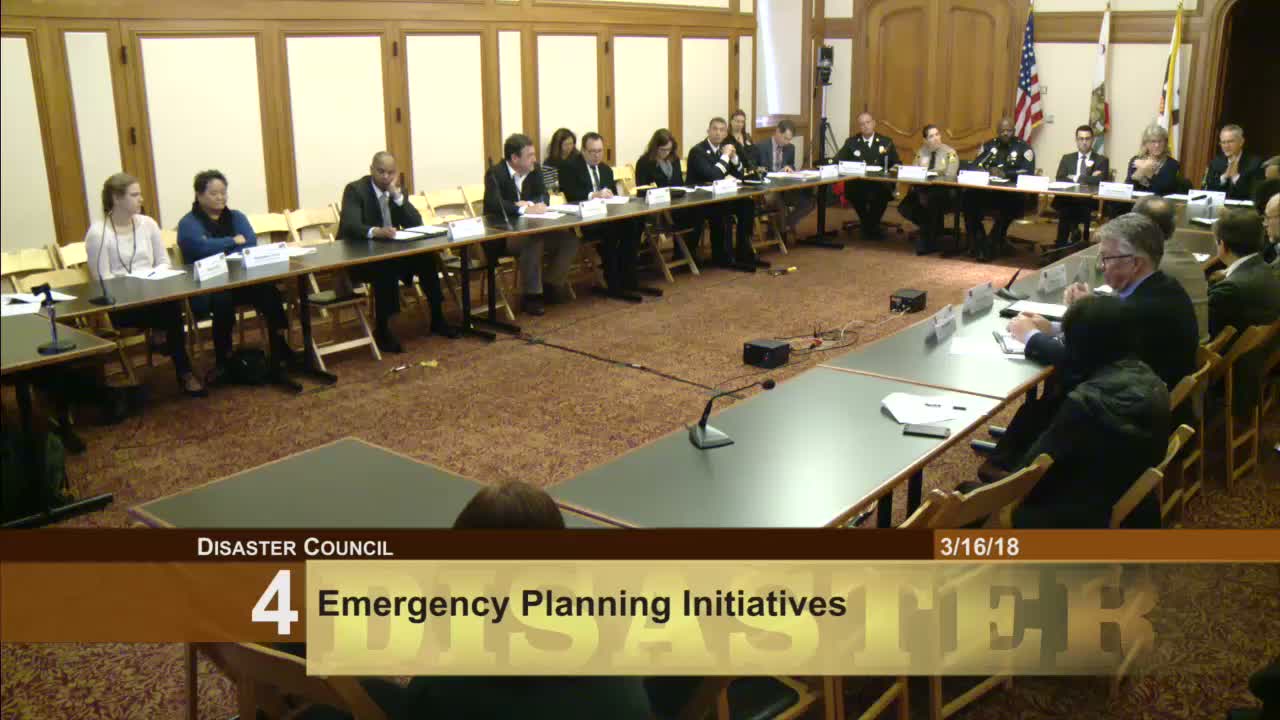
San Francisco emergency managers, fire and police officials and nonprofit partners told the Disaster Council that the city's mutual-aid response to the recent North Bay wildfires worked in many respects but exposed critical gaps in communications, staffing and surge management.
At a council meeting, Capt. Pablo Seguenza, strike-team leader (Engine 15), described entering neighborhoods with "blocks and blocks of devastation" and said the team had to rotate crews during the first 24 hours. "For the team...everybody performed over and above in a situation that we've never been in before," Seguenza said.
Why it matters: City and regional mutual-aid systems are foundational to disaster response, but officials warned the current model is strained by more frequent, larger wildfires and by personnel limits. Mike Cochran, assistant deputy chief for Homeland Security (San Francisco Fire Department), said the mutual-aid package "does work," but Deputy Director Mike Dayton and others said legislative measures are under discussion to augment mutual-aid capacity through Cal OES or grant funding.
What happened: City staff reported broad participation across departments. Dayton said about 1,000 members of the "city family" deployed to help North Bay communities. Deputy Chief Nikaya Ali (SFPD Special Operations) said the department initially sent about 30 on-duty officers and then averaged 50 to 60 officers per day on 12-hour shifts, later extending to longer shifts in the field. Kathy Johnson (for the Sheriff's Office) said the sheriff's teams executed 21 operational periods of 16 hours each with eight deputies assigned per period.
Responders identified recurring operational problems: - Communications interoperability: SFPD and sheriff's staff reported that their radio systems did not reach Sonoma County and that reliance on command vans or alternative systems was necessary. Johnson said staff received radios on site to communicate on Sonoma County frequencies. - Fatigue and logistics: Officials described 15'20-hour workdays and the need to bus personnel into the field instead of having exhausted staff drive home after long shifts. - Volunteer surge management: Trevor of the Red Cross said 18,000 people signed up to volunteer during the first month of the fires (9,000 in the first two days), and the organization ran rapid-training boot camps to integrate volunteers and credentialed clinicians who self-deployed.
Community and partner roles: The Salvation Army, Red Cross, VOAD and faith groups provided sheltering, pastoral care and other supports. The Port of San Francisco noted that many field operations remained paper-based, which complicated information sharing in EOCs. Jill Raycroft and exercise planners said recent drills (Fleet Week, Vigilant Guardian) informed deployment and medical response planning.
Officials' responses and next steps: City staff said several near-term priorities include improving radio redundancy and contingency communications (Everbridge was used as a fallback), expanding playbooks for sustained, multi-week deployments, and working with state legislators and Cal OES on possible personnel or funding augmentations. The council also highlighted upcoming exercises and the Epicenter conference as venues to refine whole-community recovery approaches.
The meeting did not produce formal votes. Officials said follow-up work will include legislative coordination and after-action debriefs with regional partners.