Get Full Government Meeting Transcripts, Videos, & Alerts Forever!
Get email alerts on the Bay Area Catastrophic Plan topic
No spam. Unsubscribe anytime.
City to convene independent review of 301 Mission as officials align local plans with state‑federal catastrophic earthquake guidance
Summary
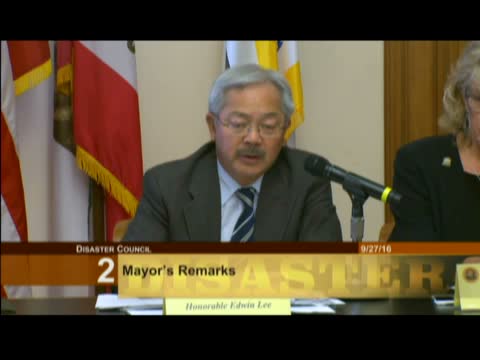
Officials briefed the Disaster Council on the Bay Area Catastrophic Plan (Cal OES/FEMA Region 9), local alignment steps, and a city‑led independent geotechnical review into the sinking and tilting reported at 301 Mission.
City emergency staff told the Disaster Council they are aligning local response plans with the state‑federal Bay Area Catastrophic Plan and launching a city‑led independent assessment of the reported sinking and tilting at 301 Mission.
Mike Dayton, deputy director for the city's emergency services division, described the Bay Area Catastrophic Plan — developed by the California Office of Emergency Services (Cal OES) and FEMA Region 9 — as a framework to "save and sustain lives, minimize suffering, stabilize and restore critical infrastructure, and then... delve into recovery." Dayton said the plan emphasizes unified state‑federal coordination, staging sites (many placed across bridges) and the need for local situation assessment in the first 24 hours after a catastrophic earthquake.
Dayton summarized modeled fault contributions to regional risk and cited the Hayward Fault as a leading contributor to modeled seismic risk, noting that the plan and USGS modeling place substantial emphasis on the Hayward Fault. The presenter also outlined planned local steps: updating the debris management plan, logistics annexes and the city’s earthquake response plan to align with the new federal and state planning assumptions, and identifying city representatives for newly defined task forces within the unified coordination framework.
Separately, city leaders announced a targeted, independent review of the reported sinking and tilting of the 301 Mission building area. An unidentified official said the city administrator, the Department of Building Inspection (DBI) and the Department of Emergency Management will co‑lead a panel of independent geotechnical experts "with no contractual relationship to any of the buildings under construction or... to give us as a city, and the board of supervisors a independent transparent analysis." The effort will examine existing engineering reports and add independent analysis covering established and proposed buildings near the Transbay Center.
Why it matters: Cal OES and FEMA planning assumptions determine state and federal resource flows in the event of catastrophic earthquakes; aligning local plans and clarifying local roles should help San Francisco receive and manage incoming state and federal support. The independent 301 Mission review responds to public concerns and seeks to provide an objective, city‑commissioned technical assessment.
What’s next: City staff will work to update local operational plans, identify city representatives for the state/federal task forces and produce the independent geotechnical review for city leadership and the Board of Supervisors.