Get Full Government Meeting Transcripts, Videos, & Alerts Forever!
Get email alerts on the Fire Safety Ordinance topic
No spam. Unsubscribe anytime.
Commission backs ordinance requiring annual tenant smoke-alarm notices and biannual compliance filings
Summary
The Building Inspection Commission unanimously supported Board of Supervisors file 160,422, which requires landlords to give tenants annual written notice of smoke-alarm requirements, mandates more robust fire-alarm audibility standards and establishes post-fire action-plan steps aimed at helping displaced tenants.
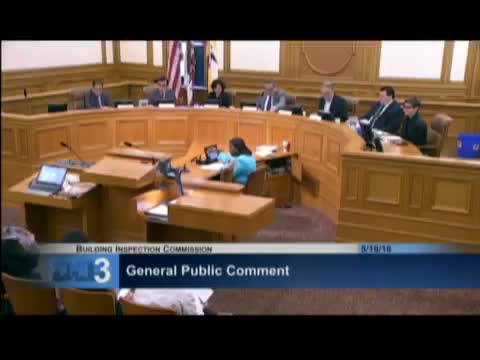
The Building Inspection Commission voted unanimously May 18 to support an ordinance (Board of Supervisors file 160,422) that would amend the fire and housing codes to require building owners to provide tenants with an annual written notice about smoke-alarm rules and to file statements of compliance for fire-alarm testing and inspection every two years.
The legislation, introduced to the commission by Carolyn Goosen, legislative aide to Supervisor David Campos, grew out of a task force convened after a spate of Mission District fires, Goosen said. "The legislation before you arises out of the many tragedies we've seen in the Mission," she said, adding the proposal also includes an "action plan to actually help tenants who are the victims of a fire." The action plan calls for immediate tenant information after a fire and a series of follow-up communications within 30 days about repairs and tenants' right to return.
Commissioners focused questions on enforcement, timelines and technical thresholds. Commissioner Walker pressed staff on what penalties would apply if owners failed to produce the required action plans or notices and asked whether incentives to speed rebuilding could be included. DBI staff explained that the notice-of-violation and abatement process in the building code (chapter 1A) would be used to enforce requirements, but acknowledged limits on the department's authority for some post-fire recovery steps. "If they don't follow that, then they would be in violation and it would follow the typical abatement process that's set forth in the building code, chapter 1A," a DBI spokesperson said.
The ordinance sets a $50,000 permit trigger for certain system upgrades, including some attic-related fire-safety work. DBI staff said the dollar threshold was developed in consultation with building owners and fire experts to capture most larger projects without burdening small permit applicants. The ordinance also adopts audibility improvements for alarm systems, citing the National Fire Protection Association standard that requires at least 75 decibels and low-frequency signals to improve detection for people with hearing loss.
Housing advocates at the meeting supported the ordinance but urged stronger enforcement. "I really implore you to examine your process and figure out a way to treat these situations as emergencies," said Tommy Avakoli Mecha of the Housing Rights Committee, who described an elderly couple who spent months sleeping in a car after a fire and said the landlord provided no written communication. Small-landlord speaker Spike Khan said he supported the measure and urged additional steps such as landlord certification of smoke-alarm installation and stronger electrical-safety requirements.
Commissioner Walker moved to support the ordinance; the motion carried on a roll-call vote with President McCarthy, Vice President Melgaard and Commissioners Clinch, Constand, Lee and Walker all voting yes. The commission's vote was a recommendation to the Board of Supervisors; the board retains final authority on any ordinance changes and implementation details.
Next steps: the commission's support will be forwarded to the Board of Supervisors for consideration; DBI staff said they will work with the fire department and community groups on outreach materials and implementation details if the ordinance proceeds.