Get Full Government Meeting Transcripts, Videos, & Alerts Forever!
Get email alerts on the Budget topic
No spam. Unsubscribe anytime.
OCII adopts $698 million FY2016–17 budget; bond refundings free $35 million for projects
Summary
The Commission on Community Investment and Infrastructure on May 3 adopted a $698 million fiscal 2016–17 budget (Resolution No. 19-2016), highlighting prior-period authority recognition, bond refunding savings that increased from an expected $13 million to $35 million, and several staffing and capital adjustments.
The Commission on Community Investment and Infrastructure on May 3 adopted its fiscal 2016–17 budget, a $698,000,000 spending plan that staff said reflects substantial prior-period authority rolled forward from earlier approvals.
Deputy Director of Finance and Administration Breema Horder told commissioners the final budget separates prior-period authority from new authority to give the public greater transparency. ‘‘In this final version of the budget, we highlight what is prior period authority versus what is new authority in this budget year,’’ Horder said, explaining the change does not alter planned spending but clarifies accounting that had been omitted in prior presentations.
Horder also described three bond transactions that closed April 21 — 2016A (Mission Bay North) and 2016B and 2016C (Mission Bay South) — and said market conditions and rating upgrades produced more savings than initially projected. ‘‘We originally projected $13,000,000 in net present value savings, but we hit the market at a really incredible time. As a result of improved ratings, rather than getting $13,000,000 in net present value savings for both funds, we got $35,000,000. So that’s pretty incredible,’’ Horder said. She said the savings reduce debt service and free additional money for reimbursement, affordable housing and other projects.
The budget also reflects program-specific changes: an increase in capital expenditure for Yerba Buena Gardens to cover repairs at the Crescent Pool after contractor notification, a work-order increase with the Mayor’s Office of Community Development (MOCD) from 0.6 full-time equivalent to 1.0 FTE to monitor affordable housing projects in construction, and the addition of an OCII FTE to transition monitoring work in-house. The Crescent Pool repair was identified at $1,200,000.
Horder said administrative-services charges were adjusted downward after feedback: the administrative services fee was decreased from approximately $99,000 to $25,000, with administrative services to bill OCII at year-end based on actuals.
Commissioner Singh asked why the budget appeared to increase “almost one-third” versus the previous year and where large sums were concentrated. Horder responded that much of the increase reflects prior-period authority — capital improvements, developer payments, affordable housing loans and other expenditures that are authorized but carried on the agency’s books from prior years — rather than a single new programmatic expansion.
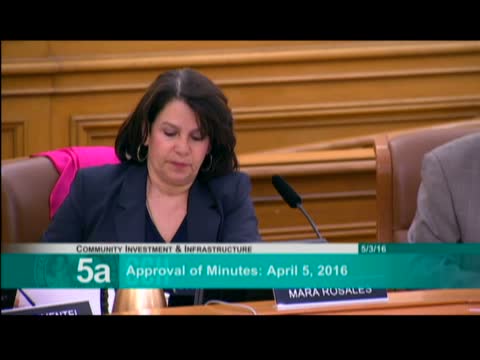
Vice Chair Mondahar moved to approve the budget (Resolution No. 19-2016); Commissioner Singh seconded. The secretary called the roll: Commissioners Pimentel, Singh, Vice Chair Mondahar and Madam Chair Rosales voted yes; Commissioner Bustos was absent. The vote was 4 ayes, 1 absent. ‘‘The budget is approved,’’ Madam Chair Rosales said.
The commission’s next steps, Horder said, are to submit the adopted budget to the mayor’s budget office for review and present the budget to the Board of Supervisors on June 8 (with a possible second hearing June 16).
Timeline and context: staff said a number of MOUs have been executed to use excess bond proceeds for city departments, and staff will continue to reconcile outstanding amounts, interest accruals and payments as they finalize the FY2016–17 schedule.