Get Full Government Meeting Transcripts, Videos, & Alerts Forever!
Get email alerts on the Area Plan topic
No spam. Unsubscribe anytime.
DAS previews 2021–24 Area Plan, flags population growth, HomeSafe pilot and COVID preparedness
Summary
San Francisco's Department of Aging and Adult Services presented its draft 2021'24 Area Plan, citing rapid senior population growth, priority populations for outreach, and program-level funding and service changes; directors also discussed HomeSafe conservatorship implementation and COVID-19 readiness.
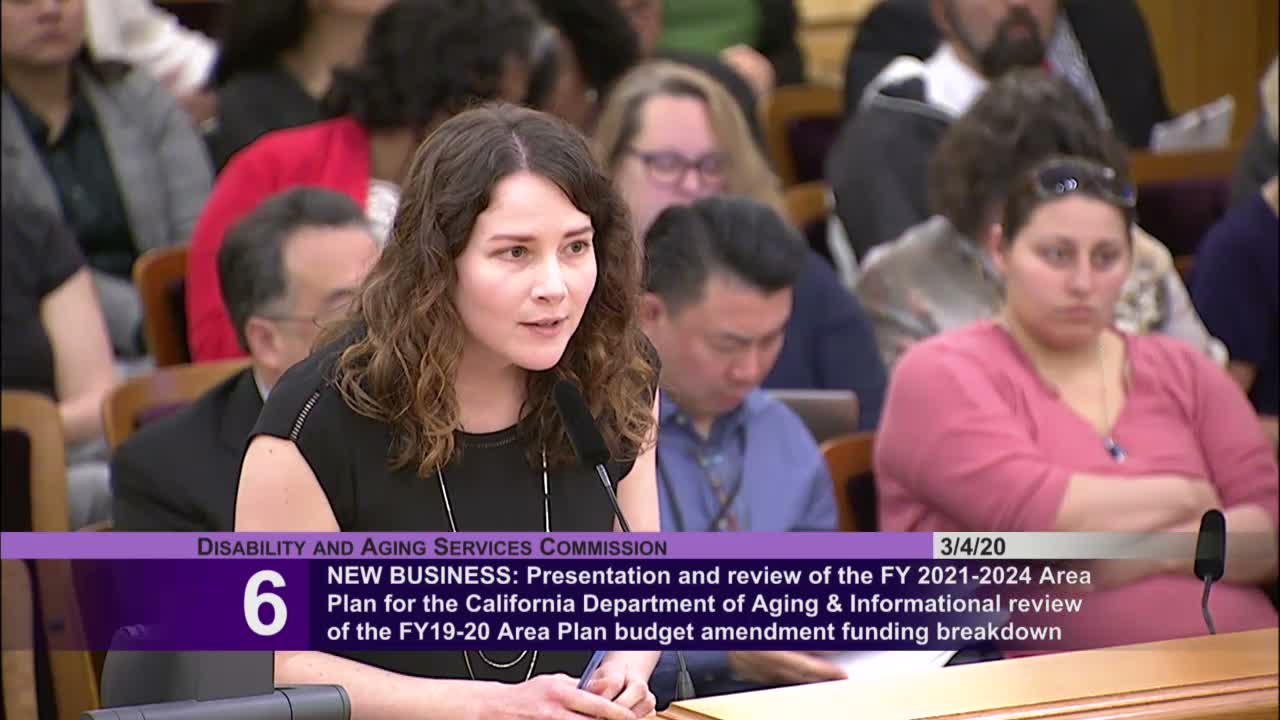
The San Francisco Department of Aging and Adult Services (DAS) presented its draft Area Plan for 2021'24 and an annual update to the advisory council, laying out goals and service priorities the department will submit to the state by May 1.
DAS Director Shereen McSpadden and HSA planning analyst Rose Johns told commissioners the plan is required by the Older Americans Act and will guide use of federal Older Americans Act funds and county coordination. Johns said the department receives roughly $7 million in state Older Americans Act dollars for community-based services, and that Title III-B funds are about $900,000 annually, with DAS supplementing those services from local funds.
"Older adults are the fastest-growing age group in the city," Johns said, reporting the senior population has increased by "almost 42,000," a roughly 30% rise that she said adds urgency to planning. The presentation highlighted priority populations identified through a dignity-fund needs assessment: socially isolated seniors, low-income residents, people with limited English proficiency, LGBTQ older adults and those at risk of institutionalization.
McSpadden outlined five strategic goals that will shape the plan: maintaining a robust network of community-based services; protecting older adults and adults with disabilities from abuse, neglect and financial exploitation; expanding consumer-centered programming; strengthening planning and evaluation; and building a trained workforce. Examples included a HomeSafe pilot to stabilize about 60 clients in FY2020'21 and a planned online resource directory to streamline access to services.
On adult-protective and conservatorship matters, McSpadden said the city is working to implement the recently passed housing conservatorship law but must coordinate with the courts, the city attorney and public defender to finalize forms and procedures. "The court has been very involved in working on the forms," she said, noting multiple legal steps before test cases proceed.
Responding to pandemic concerns, McSpadden said the city had received COVID-19 test kits and embedded staff in the Emergency Operations Center. "We have people at the emergency operations center every day," she said. She urged simple precautions for older adults and said the department is coordinating with the mayor's office and public health staff.
Johns and McSpadden also reviewed program-level shifts in the plan: DAS expects legal services units to grow by about 30% (largely from Dignity Fund investments) while other service areas remain stable or see modest changes. Alex Gleeson of HSA reported an amendment allocation of $846,235 for the current year, raising California Department on Aging (CDA) funding from $6,017,593 to $6,863,828 for FY19'20.
The advisory council will review a final draft in the coming weeks; staff said they plan to return to the commission next month to seek approval before submitting the plan to the state by May 1.
Next steps: counsel and commission review, advisory-council approval and a final commission vote ahead of the May 1 submission deadline.