Get Full Government Meeting Transcripts, Videos, & Alerts Forever!
Get email alerts on the Shakealert Early Warning topic
No spam. Unsubscribe anytime.
UC Berkeley scientist: ShakeAlert gave San Francisco seconds of warning; officials press for public rollout
Summary
Dr. Richard Allen told the council ShakeAlert detected the Napa quake and delivered about 7–8 seconds of warning in the Bay Area; he said the California portion would cost about $80 million and the West Coast system about $120 million and urged political support to make the system public.
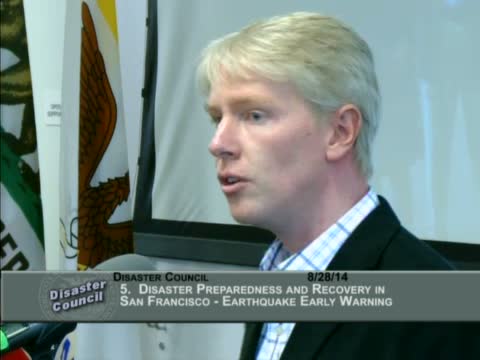
Dr. Richard Allen of the UC Berkeley Seismological Laboratory told the Disaster Council that the demonstration ShakeAlert earthquake early-warning system successfully detected the South Napa event and delivered seconds of warning to the Bay Area.
Allen described the mechanism of earthquake early warning—detecting the quake’s start, estimating shaking intensity, and pushing a warning to people in harm’s way—and said the demonstration system has been running end-to-end since 2012. He said the alert generated roughly eight seconds of advance notice in San Francisco and about five seconds at Berkeley; those brief warnings can reduce injuries and enable automatic protective actions such as slowing or stopping trains.
Allen said BART, UC Police, DEM and other agencies currently receive alerts; BART’s systems are configured to automatically slow and stop trains on an alert. He reported estimates to expand the system: roughly $120,000,000 for a West Coast-wide deployment and about $80,000,000 for the California portion, noting hardware improvements could have delivered warnings a few seconds earlier during the recent event.
Officials and Allen urged political and financial support to convert ShakeAlert from a research demonstration into a publicly available system, which would widen direct alerts to residents and expand automated protective uses.