Get Full Government Meeting Transcripts, Videos, & Alerts Forever!
Get email alerts on the Public Safety Communications topic
No spam. Unsubscribe anytime.
San Francisco unveils plan to replace aging 800-megahertz radio system, seeks $1.8M planning funds
Summary
City officials told the Disaster Council they will begin planning a $65—69 million replacement of the city—s 800-megahertz public-safety radio system, citing 13-year-old equipment and interoperability needs; the Board approved $1.8 million in planning funds and staff will begin an RFP for consultants.
San Francisco officials outlined a plan to replace the city—s aging 800-megahertz public-safety radio system, saying an upgrade is necessary to ensure interoperability for police, fire and emergency-management personnel.
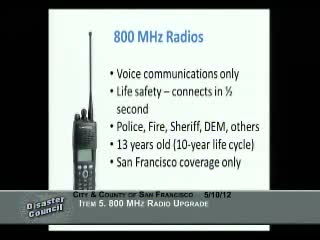
Michelle Guedes, the project manager for the 800-megahertz upgrade, told the Disaster Council the system was installed by Motorola in 2000, serves more than 7,000 users and carries roughly 100,000 push-to-talk transmissions on an ordinary day. "Our 800 megahertz system is the primary form of emergency communications in the city," she said, adding that the equipment is more than 13 years old and "needs to be replaced."
City staff presented initial cost estimates of $65 million to $69 million for a full replacement, including infrastructure and the radios themselves. The Board approved about $1.8 million in planning funding spanning two fiscal years to hire project staff and a consultant to produce a strategic rollout plan. The consultant will evaluate existing city assets, such as the SFMTA communications network, for potential shared use to reduce costs.
Mayor Mayer reiterated the administration—s priority on radios, saying, "we are making a commitment to make sure that our radio systems are upgraded." Staff said a vendor had indicated the current system reaches end-of-life around 2018 and that the city has developed a project plan aimed at cutting over to new equipment within a multi-year rollout.
Police and fire leaders and union representatives voiced strong operational support. A fire representative called the radios "our lifeline," and police officials pointed to recent large events when cellular networks degraded while radios continued to operate.
Next steps: staff will begin an RFP process to select a consultant and will return to the Disaster Council and the Board of Supervisors with further planning updates and schedule milestones.