Get Full Government Meeting Transcripts, Videos, & Alerts Forever!
Get email alerts on the Funding And Preparedness Programs topic
No spam. Unsubscribe anytime.
Officials warn of UASI funding cuts and lay out local communications, volunteer and shelter readiness plans
Summary
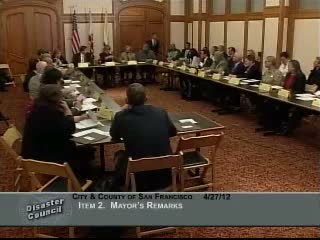
At the disaster council, city staff said the Bay Area faces a 38% UASI funding cut for 2012 and described steps to mitigate the impact, including regional communications work (BayRICS/FirstNet), a state pilot Disaster Corps, FAST teams training and public preparedness outreach.
City emergency management officials told the Disaster Council they are coping with federal funding shifts while expanding local preparedness programs.
Anne Cronenberg, the city’s director (DEM), told the council the Board of Supervisors is expected to approve second reading of 2011 UASI appropriations that "will bring about $35,000,000 into the Bay Area; of that $5,500,000 is going to San Francisco." She said the Bay Area received a 38% reduction in UASI funding for 2012 compared with the prior cycle and that local leaders, including mayors and members of Congress, have sent letters to federal officials to seek relief.
Cronenberg also summarized work on regional interoperable communications (BayRICS), noting Motorola received BTOP funds to help build out the system and that Congress recently passed legislation affecting the D Block spectrum that moves some responsibilities from the FCC to NTIA and establishes a FirstNet board to oversee a national broadband network for public safety. Cronenberg said NTIA has cautioned the region to slow some work while the new national governance structure is set up.
To bolster local capacity, Cronenberg described a California Disaster Corps pilot that would bring roughly 250 screened volunteers into a regional register to support operations that require background checks, and said DEM trained more than 50 personnel to serve on local Functional Assessment Service Teams (FAST) to address disability needs in emergency shelters.
Resilience and recovery manager Alicia Johnson described a retail partnership and a "Who are you shopping for" campaign with printed checklists, radio spots and web links to the city’s "72 hours" preparedness page. Michael Pappas of the San Francisco Interfaith Council said his organization’s May 2 conference has exceeded planned capacity and will showcase a neighborhood 'resilient‑bill' tabletop exercise supported by California Pacific Medical Center and the Walter and Elise Haas Fund.
Representatives from the private sector and city finance offices also spoke: Kenny Cleveland of the Building Owners and Managers Association thanked city agencies and announced downtown building evacuation drills in August; a controller’s office representative said FEMA cost‑recovery training for finance staff will be offered in May to improve post‑incident reimbursement capability.
Deputy Chief of Special Operations briefed the council on coordination with the Golden Gate Bridge Authority and CHP for a planned First Amendment action on the bridge, reiterating CHP's role as the lead law enforcement agency and noting multiple agencies have planning components to facilitate and respond to the activity.
The council recorded these updates as planning and outreach measures rather than actions that change policy or appropriations.