Get Full Government Meeting Transcripts, Videos, & Alerts Forever!
Get email alerts on the Municipal Budget topic
No spam. Unsubscribe anytime.
Building Inspection Commission approves budget with $1 million reserve amendment
Summary
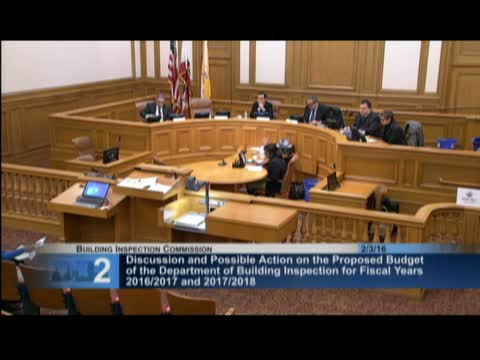
The Building Inspection Commission unanimously approved the Department of Building Inspection’s proposed biennial budget with an amendment adding $1,000,000 to the department’s 2017–18 designated general reserve, with staff to work the budget through the mayor’s and Board of Supervisors’ processes.
The Building Inspection Commission on Feb. 3 reviewed the Department of Building Inspection’s proposed biennial budget and voted unanimously to approve it with an amendment adding $1,000,000 to the department’s designated general reserve for fiscal year 2017–18. Commissioner Walker moved the amendment; it was seconded and passed on a roll-call vote of the five commissioners present.
Tyrus Madison, Deputy Director for the Department of Building Inspection, told commissioners the proposal is grounded in department goals and an earlier strategic plan and largely builds on the previously approved base. "This budget, similar to prior budgets, is based on the department's goals," Madison said, listing plan priorities including plan review, inspections, outreach and customer service. He reported revenue strength, saying, "for the first 6 months of the fiscal year, we've actually collected, dollars 11,000,000 more than we did last fiscal year," and noted staff has adjusted the revenue estimate upward from $59,000,000 to about $61,000,000.
Why it matters: Commissioners debated reserving funds to support code-enforcement outreach and programs to legalize units, including a possible loan or pilot program administered in coordination with the Mayor’s Office of Housing. Commissioner Walker said a targeted reserve could help finance legalization and outreach and asked that the commission proactively recommend adding the designated reserve for the 2017–18 request. Walker said the approach should be realistic and revisited annually if the pilot proves successful.
Discussion and details: Commissioners and staff discussed how the two-year budgeting proposal would operate in practice and how mid-course adjustments would be handled. Madison explained that after approval the budget is due to the mayor’s/controller’s office on Feb. 22 and that supplemental appropriations or mid-cycle adjustments would require additional action: "you have to wait until the next budget year, or you have to go in and request a supplemental appropriation," he said. The presentation also identified modest expenditure increases for salaries and fringe benefits, community outreach (including multilingual materials), vehicle replacements and services to other departments; Madison said the overall DBI budget remains near $75,000,000.
Cost context and program design: Commissioners discussed estimates for the cost of legalizing units and pilot mechanics. Madison noted a typical legalization cost example of about $50,000 per unit. Commissioners emphasized that any pilot fund should be designed so that it can be scaled or revisited if demand exceeds available funds and that local pilot funding could be used to leverage state or federal matching dollars.
Vote and next steps: Commissioner Walker moved to "approve the budget with the addition of $1,000,000 in the 'seventeen and 'eighteen Department request line item for designated for General Reserve." The motion was seconded and passed on a roll-call vote: President McCarthy — yes; Commissioner Clinch — yes; Commissioner Constance/Conston — yes; Commissioner Lee — yes; Commissioner Walker — yes. The commission chair announced, "the motion carries unanimously." The budget will proceed to the mayor’s and controller’s offices and is scheduled for presentation to the Board of Supervisors in June; the city typically adopts the budget by July.
The commission adjourned at 9:50 a.m.