Get Full Government Meeting Transcripts, Videos, & Alerts Forever!
Get email alerts on the Housing Preservation topic
No spam. Unsubscribe anytime.
DBI Commission asks for more review of ordinance to limit removal of residential units
Summary
The Building Inspection Commission continued action on a supervisor‑sponsored ordinance that would require Planning Commission conditional‑use approval before owners could remove any residential unit and would require owners to legalize many unauthorized units unless removal is approved. Commissioners asked staff and the code advisory committee to refine exemptions, cost safeguards and NOV procedures and continued the item to Feb. 17.
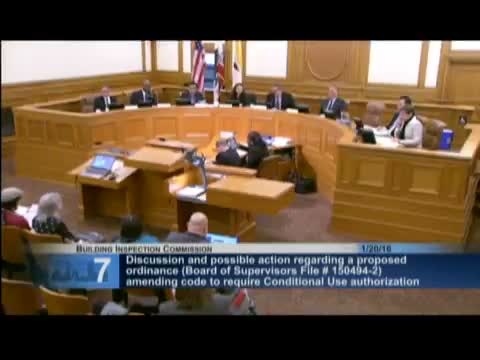
President McCarthy opened the discussion of a proposed ordinance the Board of Supervisors introduced that, as read into the record, would amend the Planning Code and Building Code to require conditional use authorization for the removal of any residential unit and to link notice‑of‑violation (NOV) remedies for unauthorized units to a requirement to legalize the unit unless the Planning Commission approves removal.
Jeremy Pollack, legislative aide to Supervisor John Avalos, told the commission the ordinance aims to preserve rent‑controlled and affordable housing by closing loopholes that let units be removed without tenant notice or recourse. Pollack said the measure would also require conditional‑use review for conversions of spaces long used as residences back to commercial use, a practice advocacy groups say has driven evictions in areas such as mid‑Market.
Kimia Herrera of the Planning Department explained the two main code changes: make removal rules consistent across zoning and unit counts by subjecting removals to conditional‑use review, and add a broad definition of an "unauthorized unit" with a screening process at the planning counter. Under the draft, an "unauthorized unit" is an independent living or sleeping area that has been used independently as a dwelling and that has independent access not through another dwelling unit. Planning staff described three review criteria the Planning Commission would use in CU decisions: (1) whether a unit is eligible for legalization, (2) whether legalization is financially feasible (an appraisal would be required), and (3) whether the cost of legalization is reasonable compared with the program's historic cost range.
Planning staff provided data intended to illustrate the scope of the problem: roughly 180 applications for removal of unauthorized units have been filed since May 2014, roughly 31 units were "priced out" by an affordability threshold in the past five years, and 16 demolitions were permitted as unsound structures in the same period. Staff estimated the CU process averages six to nine months and that permit application costs for the process are commonly in the $4,000'$5,000 range.
DBI staff raised implementation questions. Ed Sweeney, Deputy Director for Plan Review, noted that legalizing or changing occupancy can trigger building code upgrades, such as sprinklers, and that DBI must ensure life‑safety exemptions are preserved. Rosemarie Boske, Chief Housing Inspector, warned the commission that placing a directive on an NOV that an owner must legalize a unit could create practical problems if a CU review, feasibility study or appraisal takes months; she urged clearer language identifying imminent life‑safety exceptions and a workable process for screening and coordinating DBI and Planning roles.
Tenants and housing advocates urged the commission to adopt the policy, saying owners have sought to convert long‑standing residential or live/work spaces back to commercial use, leaving tenants with little notice. Builders and the Code Advisory Committee supported the policy objective but asked for narrower, clearer definitions and for safeguards so small owners are not forced into costly CU processes that could invite lawyers and delays.
After extended discussion about exemptions (single‑family homes, units with no legal path to legalization), the NOV status during the CU review, funding assistance to help owners legalize units, and how the ordinance would interact with other pending legislation, Commissioner Walker moved to continue the item so the supervisor's office, Planning, DBI staff and the Code Advisory Committee could work on amendments. The motion was seconded and the commission voted by roll call to continue the ordinance to the commission's next regular meeting on Feb. 17; the motion carried unanimously.
The item will return for further review with suggested drafting changes to clarify the unauthorized‑unit definition, exemptions for imminent life‑safety hazards or units with no legal path to legalization, options for placing NOVs on hold for owners acting in good faith, and potential funding mechanisms to assist low‑income homeowners to legalize units.
The Commission did not take a final vote on the ordinance at this meeting; the matter was continued to Feb. 17.