Get Full Government Meeting Transcripts, Videos, & Alerts Forever!
Get email alerts on the Senior Services topic
No spam. Unsubscribe anytime.
San Francisco department preserves some senior college classes, reports early progress on HomeSafe pilot
Summary
The Department of Disability and Aging Services told commissioners it used one-time Dignity Fund dollars to preserve 17 older-adult classes cut by City College and reported that the HomeSafe pilot (launched July 1 with $773,000 in state funds) enrolled 25 people and aims to serve 120 over two years.
The San Francisco Department of Disability and Aging Services said Friday that it has stepped in to preserve a subset of older-adult classes City College eliminated in recent budget cuts and that a state-funded homelessness-prevention pilot is on track.
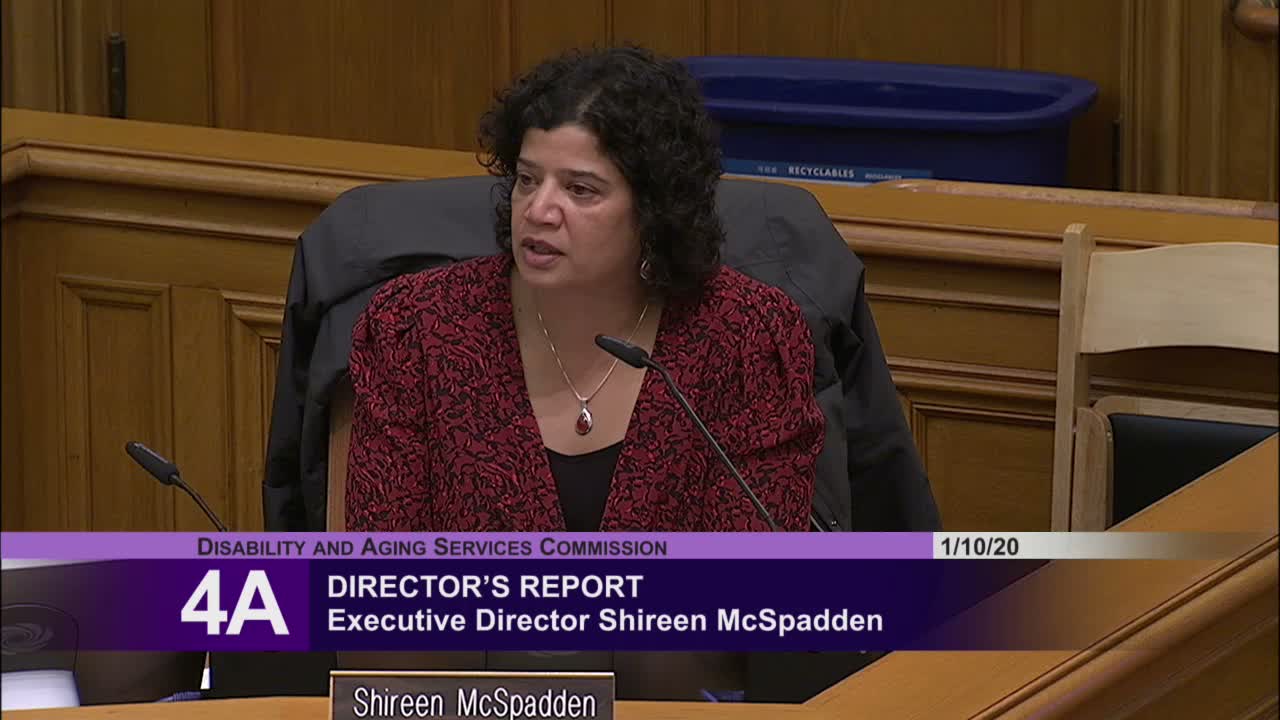
Executive Director Shereen McSpadden told the department's commission the city used one-time Dignity Fund allocations, structured over three years, to restore 17 classes that were slated for elimination after City College reduced its older-adult learning program. "Because they happen to be in senior centers that we already fund," McSpadden said, "we will be able to fund them directly to continue the classes in those sites for three years." She said roughly 50 of 58 older-adult classes were cut in the college's budget and that the preserved classes are those the department already had partnerships with.
McSpadden framed the move as a bridge while the city and community discuss longer-term solutions. Commissioners pressed staff on whether there will be a broader strategy to restore additional classes; McSpadden said further community discussion and planning are needed and that the preserved courses are intended as an interim measure.
On program implementation, the department also reported progress on HomeSafe, a pilot launched July 1 with $773,000 in state funds to serve older adults at risk of homelessness. McSpadden said 25 individuals had been enrolled in the first six months, and that the two-year pilot anticipates serving 120 clients. "APS and the Institute on Aging provide case management and purchase of services for clients who are at risk," she said, adding that quarterly meetings among partners are under way to monitor implementation.
The director highlighted other priorities tied to the department's strategic plan: expanding caregiver supports and IHSS enrollment processes, rolling out trauma-informed training with the Department of Public Health, and continuing the Reframing Aging public-awareness campaign that ran October through December and has produced more than 3,700 online pledges.
McSpadden cautioned that some operational details remain under development, especially the mechanics of shifting classes from City College to community sites. She described the preservation funding as "one-time-only money" that has been allocated across three years and therefore not guaranteed beyond the term described. Commissioners asked department staff to return with more specifics as plans evolve.
The commission did not take separate action on the director's report; it moved on to other agenda items after Q&A.