Get Full Government Meeting Transcripts, Videos, & Alerts Forever!
Get email alerts on the Communications Infrastructure topic
No spam. Unsubscribe anytime.
Bay Area leaders outline BAYWEB public‑safety broadband plan, Motorola BOOM proposal
Summary
San Francisco emergency managers and interoperability staff described BAYWEB, a dedicated Bay Area 4G LTE network for public safety funded by a Motorola BTOP/ARRA grant and a proposed 10‑year build‑own‑operate‑maintain contract that would transfer the system to a regional authority after the term.
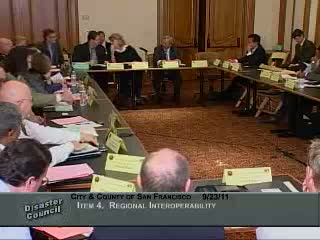
Barry Frasier, interoperability manager for the San Francisco Department of Emergency Management, told the Disaster Council that the Bay Area is advancing BAYWEB (Bay Area Wireless Enhanced Broadband), “a network —… exclusively for public safety and first responders.” He described it as a private 4G LTE data network intended to keep public-safety traffic off commercial carriers during emergencies.
Frasier said the project rests on three building blocks already in hand: a waiver of 700 MHz spectrum from the Federal Communications Commission; ARRA/BTOP funding awarded to Motorola; and a new regional governance body to oversee the system. “San Francisco, Oakland, and San Jose applied to the FCC for a waiver to begin building the network on this spectrum early, and we received that waiver,” he said.
Under the proposal discussed at the council, Motorola would build, own, operate and maintain the system for 10 years under a BOOM agreement and then transfer the system to the Bay Rx authority at no cost. Frasier said Motorola had received a BTOP/ARRA award and was proposing a $21,000,000 match in addition to about $50,000,000 in federal stimulus funding for the build. He also said the project team was “tentatively looking at $38 a month per user for the first year,” after which rates would be adjusted but are constrained by grant conditions to remain below market rate for the 10‑year term.
Frasier emphasized the limits and benefits of the network. “This network does not support mission critical voice communications at this time,” he said, noting it is intended to augment—not replace—the existing land mobile radio voice systems. He described features that the LTE platform would enable for responders, including prioritized data transmission for commanders, near real‑time photo and video sharing, region‑wide device interoperability and secure, dedicated connections for eligible public‑safety users.
Next steps outlined for council members included negotiating site‑use agreements with local site owners, the Bay Rx authority’s adoption of a system funding plan and final approval of the BOOM agreement by each member jurisdiction. Frasier said the team was “getting to the end” of negotiations and aimed to have members sign a final BOOM agreement by December 6 to meet the aggressive BTOP/ARRA timeline.
The presentation concluded with Frasier inviting follow‑up questions and offering his contact information for jurisdictions and agencies that want detailed technical or contractual briefings.