Get Full Government Meeting Transcripts, Videos, & Alerts Forever!
Get email alerts on the Disaster Council Organization topic
No spam. Unsubscribe anytime.
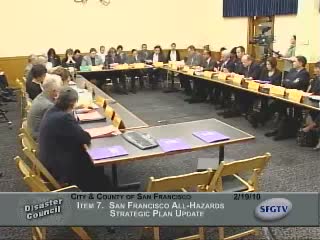
Disaster Council reorganization and Lifelines Council aim to improve citywide recovery coordination
Summary
DEM outlined a reorganization to clarify the Disaster Council’s oversight role, emphasize Disaster Preparedness Coordinators and mission-area work groups, and introduced a Lifelines Council co-chaired by Ed Lee to coordinate utility restoration priorities across agencies.
The Department of Emergency Management presented an organizational update to the Disaster Council aimed at clarifying roles, reducing duplication, and improving accountability for preparedness and recovery work.
Vicky Hennessy reviewed the Disaster Council’s mandate under City Administrative Code Chapter 7 and described an effort to align the council, the Homeland Security Executive Steering Committee, mission-area steering groups and Disaster Preparedness Coordinators so that operational work is conducted by subject-matter experts and decisions are transparent and accountable to the council.
Hennessy said the approach keeps the council as a public forum and oversight body while relying on preparedness coordinators — who meet regularly — to implement and update the All Hazards Strategic Plan, continuity-of-operations plans, and mobilization plans. She stressed the need to institutionalize the incident command system across departments and to maintain liaison with external agencies.
Heidi Seek of the General Services Agency described the Lifelines Council, a 75-project program co-chaired by Ed Lee and Chris Poland that brings infrastructure and lifeline leaders together to identify interdependencies and prioritize restoration and reconstruction activities. "We bring all of the infrastructure and lifelines leaders together to talk about how their networks are interdependent," Seek said, adding that meetings included presentations from the Public Utilities Commission, PG&E and upcoming presentations from telecom firms.
Ed Lee said the council’s unique value is identifying gaps — for example, PG&E’s ability to restore systems might depend on getting its workforce back into the city — and coordinating transport and workforce priorities accordingly. City staff said the All Hazards Strategic Plan update and lists of recurring meetings are posted for stakeholders, and invited council members to ensure appropriate representation at recurring work groups.
A SPUR representative offered a draft paper on emergency governance and recommended a strengthened executive committee to provide annual priorities and strategic oversight; a March 31 event on seismic early-warning systems was also announced during public comment.